Video Wall Cost Breakdown: Hardware, Installation, Content, and Ongoing Management
3 minute read | Updated July 31, 2026
For any developer or property manager weighing a video wall for a lobby, directory, or public-facing space, the question that inevitably comes up is simple: what does it actually cost? The honest answer is that a video wall isn't a single line item — it's an investment that unfolds across four distinct categories: hardware, installation, content, and ongoing management. Understanding how these pieces fit together makes it far easier to build an accurate budget, compare vendor quotes on equal footing, and plan for the full lifecycle of the display rather than just the sticker price of the panels.
This breakdown walks through what drives cost in each category, what a realistic budget range looks like for a commercial lobby or directory installation, and how to think about total cost of ownership — not just the upfront number — when planning a video wall for your property.
Hardware: The Largest Upfront Investment
Hardware — the display panels themselves — is typically the single largest cost category, and pricing varies enormously depending on the technology and specification chosen.
LCD video walls remain the more budget-predictable option for standard installations. Commercial-grade 55-inch LCD panel systems (displays, mounting, controller, and basic configuration) typically fall into clear pricing tiers based on pixel pitch and viewing distance requirements, making LCD a straightforward choice to budget for since it's built from familiar, mass-produced commercial display panels. DisplayDetails
LED video walls are priced per square foot (or square meter) and pixel pitch is the number that moves the price most. In 2026, installed direct-view LED runs roughly $400–$900 per square foot for coarser outdoor pitch, $500–$900 for standard indoor pitch, $900–$1,600 for premium P2.5-class pitch, $1,500–$2,500 for fine P1.5–P1.9 pitch, and $2,500–$4,000-plus per square foot for premium sub-P1.2 micro-pitch walls designed for very close viewing. To put that in real terms: a typical 12-by-7-foot lobby wall at a mid-range 1.8mm pitch generally lands around $60,000–$100,000 turnkey, including structure, processing, and installation. CrownTVCrownTV
Several factors compound these baseline numbers:
Pixel pitch is the primary cost driver. A 1.5mm pixel pitch panel contains roughly 6.7 times more LED components than a 3.9mm panel of the same physical size, which is why finer-pitch walls designed for close viewing cost significantly more than coarser-pitch walls meant to be viewed from a distance. The practical takeaway for a property manager: matching pitch to actual viewing distance, rather than defaulting to the finest pitch available, is one of the most effective ways to control hardware cost. SV Solutions
Outdoor and weatherproof hardware carries a premium. Outdoor LED cabinets are typically 60–80% heavier and 30–40% more expensive per square foot than an equivalent indoor panel, reflecting the sealed housing, extended-temperature thermal management, and higher-brightness components needed to remain legible and durable outdoors. SV Solutions
Bulk and scale can meaningfully lower per-unit costs. Larger installations spread fixed engineering and procurement costs across more square footage, which is part of why enterprise and portfolio-wide video wall programs often achieve better pricing than one-off single-building projects.
Installation: More Than Just Mounting a Screen
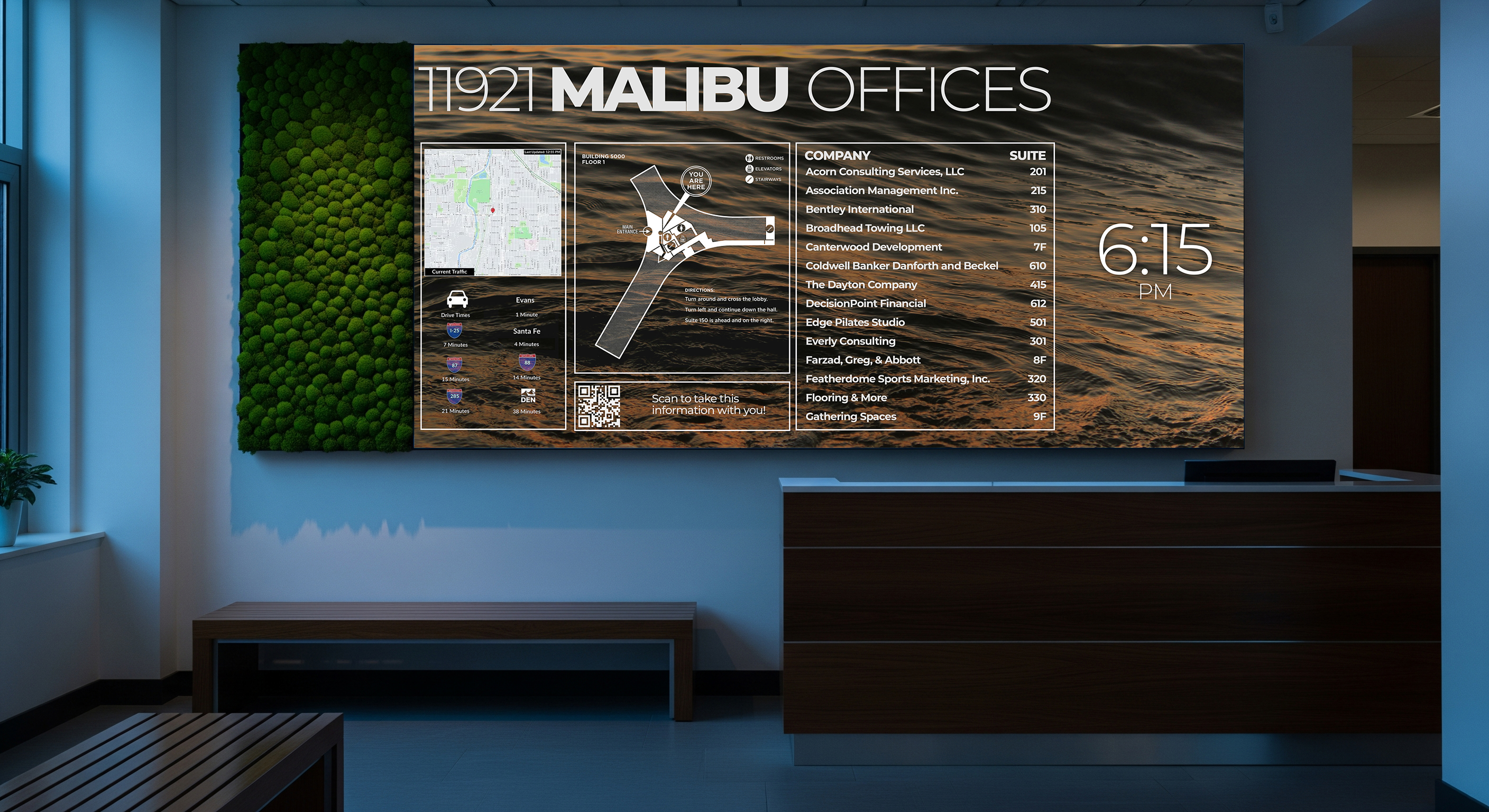
Installation costs are frequently underestimated in early budgeting, but they can meaningfully shift the total project cost — particularly for video walls, which require more precision than a single standalone display.
Installation fees for LED video walls typically run 15–30% of hardware costs, and video wall projects specifically often carry additional commissioning work beyond a standard signage install. Video walls add a commissioning premium of roughly $500–$1,500 per panel for alignment and color calibration alone, on top of standard mounting labor. Installation and commissioning together typically add 10–20% to the total project cost, with curved, suspended, or custom-shaped configurations requiring a higher installation budget due to the added engineering involved.
A few site-specific factors that commonly affect installation cost:
Electrical and network infrastructure. Retrofit installations often require a hardwired network drop, since Wi-Fi alone isn't reliable enough for production signage, and cabling or electrical work can run $150–$500 per screen, with dedicated electrical work adding further cost when outlets aren't already positioned where the wall will go.
Mounting complexity. Video wall mounting systems for even a modest 2x2 configuration typically start around $800, and unusual surfaces — glass, stone, or curved walls — require specialty engineering that adds to the total.
Structural and access considerations. Larger installations, high ceilings, or difficult access points may require lift equipment or additional labor hours, which is why an on-site survey early in the planning process is one of the best ways to avoid budget surprises later.
Content: The Ongoing Cost Most Properties Underestimate
Content is where many video wall budgets go wrong — not because content is expensive per instance, but because it's a recurring cost that continues for the entire life of the display, and it's often left out of the initial budget entirely. A reasonable planning benchmark is to expect to spend 30–50% of the hardware budget on content in the first year alone, covering everything from directory graphics and wayfinding templates to branded video and seasonal or tenant-specific campaigns.
For most commercial lobby, directory, and wayfinding applications, this cost is manageable because much of the content is template-driven — directory listings, tenant updates, and wayfinding maps that update through a content management system rather than requiring custom video production for every change. Properties that plan to use their video wall primarily for building communications, tenant announcements, and wayfinding will generally see far lower ongoing content costs than those using the wall as a dynamic advertising or brand storytelling platform requiring frequent custom video assets.
Ongoing Management: Software, Support, and Maintenance
The final — and most consistently recurring — cost category covers the content management system (CMS) software, technical support, and hardware maintenance needed to keep a video wall running reliably for years.
Content management software is typically billed per screen, per month, and pricing varies by platform tier. Cloud-based CMS platforms generally run $10–$50 per screen per month, while many vendors offer tiered pricing that decreases per-screen cost as more screens are added to a network — for example, dropping from around $25 per screen per month for a small deployment to $12 per screen per month or less for a large, multi-location portfolio. Enterprise-grade platforms with advanced features, analytics, and integrations can run higher. On-premise licensing, by contrast, requires a higher upfront per-screen purchase along with annual maintenance and update fees typically running 15–20% of the original license cost, plus the IT overhead of managing on-site servers — one reason many properties now favor cloud-based platforms for predictable, centrally managed budgeting.
Support and maintenance should be planned as a recurring line item rather than an occasional expense. Managed service contracts typically run $20–$100 per screen per month, while per-incident service calls generally cost $150–$300 per hour, plus parts and travel for issues outside a service plan's coverage. Choosing a managed service model — versus paying for support only when something breaks — often provides more predictable budgeting and faster response times, which matters most for a display visitors and tenants see the moment they walk into the building.
Total cost of ownership, when properly modeled, includes hardware, installation, software licensing, content production, and maintenance across the full expected life of the display — a useful framework is: Total Cost of Ownership = Hardware (one-time) + Installation (one-time) + Software Licensing (recurring) + Content Creation (recurring) + Maintenance and Support (recurring). Viewing the investment through this lens, rather than focusing solely on the hardware quote, gives property teams a far more accurate picture of what a video wall will cost to own — and helps ensure the budget holds up well beyond opening day.
Budgeting With a Long-Term Partner, Not Just a Vendor
The properties that get the most value from a video wall investment are typically the ones that plan for all four cost categories from day one — and work with a partner who manages hardware, installation, content, and ongoing support as one coordinated program rather than four separate transactions. That's the model behind Navigo® by ITS, Inc.: a single point of accountability for the full lifecycle of your video wall, from initial specification through years of content updates and technical support.
Since 1999, we've helped commercial office towers, healthcare systems, transit authorities, and mixed-use developments across the US and Canada budget accurately and deploy confidently. Learn more about our video wall solutions, see how these investments come together across our portfolio, and explore the technology fundamentals in our companion guides, What Is a Video Wall? and our Video Wall Buyer's Glossary.
Planning a video wall and want an accurate, all-in budget for your property?
The Navigo® team can walk you through hardware, installation, content, and management costs tailored to your specific space and goals.
Connect with us today.
Frequently Asked Questions
How much does a typical lobby video wall cost overall?
It depends heavily on technology and size, but a common reference point for a mid-size lobby installation gives a useful benchmark: a typical 12-by-7-foot lobby wall at a mid-range 1.8mm pixel pitch generally lands around $60,000–$100,000 turnkey, including structure, processing, and installation. Smaller LCD-based directory or lobby displays can come in well below that range, since standard commercial-grade LCD panel systems are priced in clear tiers based on pixel pitch and viewing distance requirements rather than the higher per-square-foot costs associated with fine-pitch LED.
Why does pixel pitch have such a big impact on hardware cost?
Pixel pitch determines how many individual LED components are packed into a given area, and that difference compounds quickly. A 1.5mm pixel pitch panel contains roughly 6.7 times more LED components than a 3.9mm panel of the same physical size, which is why fine-pitch walls built for close viewing cost meaningfully more than coarser-pitch walls designed to be viewed from farther away. Choosing pitch based on actual viewing distance, rather than the finest option available, is one of the most reliable ways to keep hardware costs aligned with what a space actually needs.
Is LED always more expensive than LCD?
Not necessarily — it depends on size and viewing distance. For close-viewing installations at moderate sizes, LCD is often the more cost-predictable option since it's built from familiar, mass-produced commercial panels. For very large or seamless installations, the cost gap narrows considerably, and LCD video walls are generally easier to budget for because they're built from standard commercial displays, while LED becomes a stronger fit for brand spaces and large public displays where visible bezel lines would interrupt the image — a visual outcome that isn't achievable with tiled LCD at any price point.
How much should I budget for installation on top of the hardware cost?
Installation is a meaningful line item, not an afterthought. Installation fees for LED video walls typically run 15–30% of hardware costs, and video wall projects specifically often carry an additional commissioning cost for alignment and calibration: roughly $500–$1,500 per panel on top of standard mounting labor. Site conditions — existing electrical infrastructure, network access, and wall surface — can shift this number meaningfully, which is why an on-site survey early in planning helps avoid budget surprises later.
What's the biggest budgeting mistake properties make with video walls?
Underestimating content as an ongoing cost rather than a one-time expense. A reasonable planning benchmark is to expect to spend 30–50% of the hardware budget on content in the first year alone, and that cost continues for the life of the display, not just at launch. Properties that plan primarily for template-driven content — directory listings, wayfinding, and tenant updates — typically see far lower ongoing content costs than those planning frequent custom video production.
How much does the content management software (CMS) typically cost?
CMS pricing is usually billed per screen, per month, and scales with the size of your network. Cloud-based CMS platforms generally run $10–$50 per screen per month, and many vendors offer tiered pricing that decreases the per-screen rate as more screens are added — for example, dropping from around $25 per screen per month for a small deployment to $12 or less per screen per month for a large, multi-location portfolio. Cloud-based platforms also avoid the added IT overhead that comes with on-premise licensing models.
Should I budget for ongoing maintenance and support separately from software?
Yes — these are typically distinct cost categories. Managed service contracts generally run $20–$100 per screen per month, while per-incident service calls typically cost $150–$300 per hour, plus parts and travel for anything outside a service plan's coverage. For a display that's central to how tenants and visitors experience your building, a predictable managed service plan is usually a better long-term value than paying for support only when something breaks.
What's the best way to think about total cost of ownership rather than just the upfront price?
The most useful framework accounts for every cost category across the full life of the display: Total Cost of Ownership = Hardware (one-time) + Installation (one-time) + Software Licensing (recurring) + Content Creation (recurring) + Maintenance and Support (recurring). Evaluating a video wall quote through this lens — rather than focusing only on the hardware price — gives property teams a much more accurate picture of what the investment will actually cost over five or ten years, and helps avoid gaps in the budget after installation day.
Does bundling hardware, software, and support with one provider actually save money?
It often does, primarily by reducing coordination overhead and preventing compatibility issues between components sourced from different vendors. Buying displays, mounting, controllers, and CMS from different vendors can create compatibility headaches and finger-pointing when something goes wrong, while a turnkey solution from a single provider simplifies procurement, support, and warranty coverage. A single point of accountability across hardware, installation, content, and ongoing management also tends to produce more predictable long-term budgeting than managing several vendor relationships independently.
Contact us today to learn more about Navigo® for your property.