

Headquarters
7150 Columbia Gateway Drive, Suite L, Columbia, MD 21046
New York Location
112 West 34th Street, 18th floor, Room 18025 New York, NY 10001
Proud Member


The Tech-Forward Retail Shift: How Seattle Boutiques Are Using Interactive Displays to Elevate the In-Store Experience2 minute read | Updated June 19, 2026
Seattle has always been a city that lives at the intersection of innovation and community. From the engineers who commute to Bellevue tech campuses to the independent shop owners who built Capitol Hill's eclectic retail culture, this is a city that doesn't just adopt technology — it expects it. And right now, that expectation is reshaping what it means to walk into a store. For Seattle's brick-and-mortar retailers, the physical shopping experience is no longer just a place to transact. It's becoming a destination — a sensory, personalized, and deeply interactive environment that digital storefronts simply cannot replicate. The brands winning in this space aren't doing so by working harder at traditional retail. They're doing it by creating smarter stores. Interactive touch screen solutions are at the center of that transformation.
Why Physical Retail in Seattle Is Primed for This MomentSeattle's retail landscape is uniquely positioned to lead in experiential technology. The city sits at the intersection of several powerful forces: a highly educated and tech-literate consumer base, a strong independent retail culture in neighborhoods like Capitol Hill, Fremont, and South Lake Union, and a growing appetite for curated, in-person experiences that digital shopping can't deliver. According to the International Council of Shopping Centers (ICSC), 72% of shoppers say they still prefer to touch and experience products before buying — even among consumers under 35.¹ In a city where the average consumer has high digital fluency and equally high expectations, that preference doesn't disappear. It escalates. Shoppers want the best of both worlds: the tactile reality of in-store, enhanced by the infinite depth of digital. That's precisely the opportunity interactive displays unlock.
The Endless Aisle: Turning Square Footage Into Infinite InventoryOne of the most immediate and measurable wins retailers are seeing with interactive touch screens is the concept of the "endless aisle" — in-store kiosks or display systems that allow shoppers to browse a retailer's full catalog, including out-of-stock, online-only, or extended-size inventory, directly from the sales floor. For a boutique in Capitol Hill with 1,200 square feet of retail space, the physical constraint of inventory is real. But with a well-placed interactive display, that same boutique can present every colorway, every size, and every style — and allow customers to place an order for home delivery or in-store pickup on the spot. The data supports this approach powerfully. A McKinsey & Company study found that retailers deploying endless aisle technology saw an average increase of 10–30% in conversion rates for previously unavailable items.² Separately, Forrester Research has noted that shoppers who engage with digital touchpoints in-store spend an average of 13% more per visit than those who don't.³ For Seattle's independent retailers competing on differentiation rather than volume, that kind of lift isn't just meaningful — it's potentially the difference between a thriving flagship location and a shuttered one.
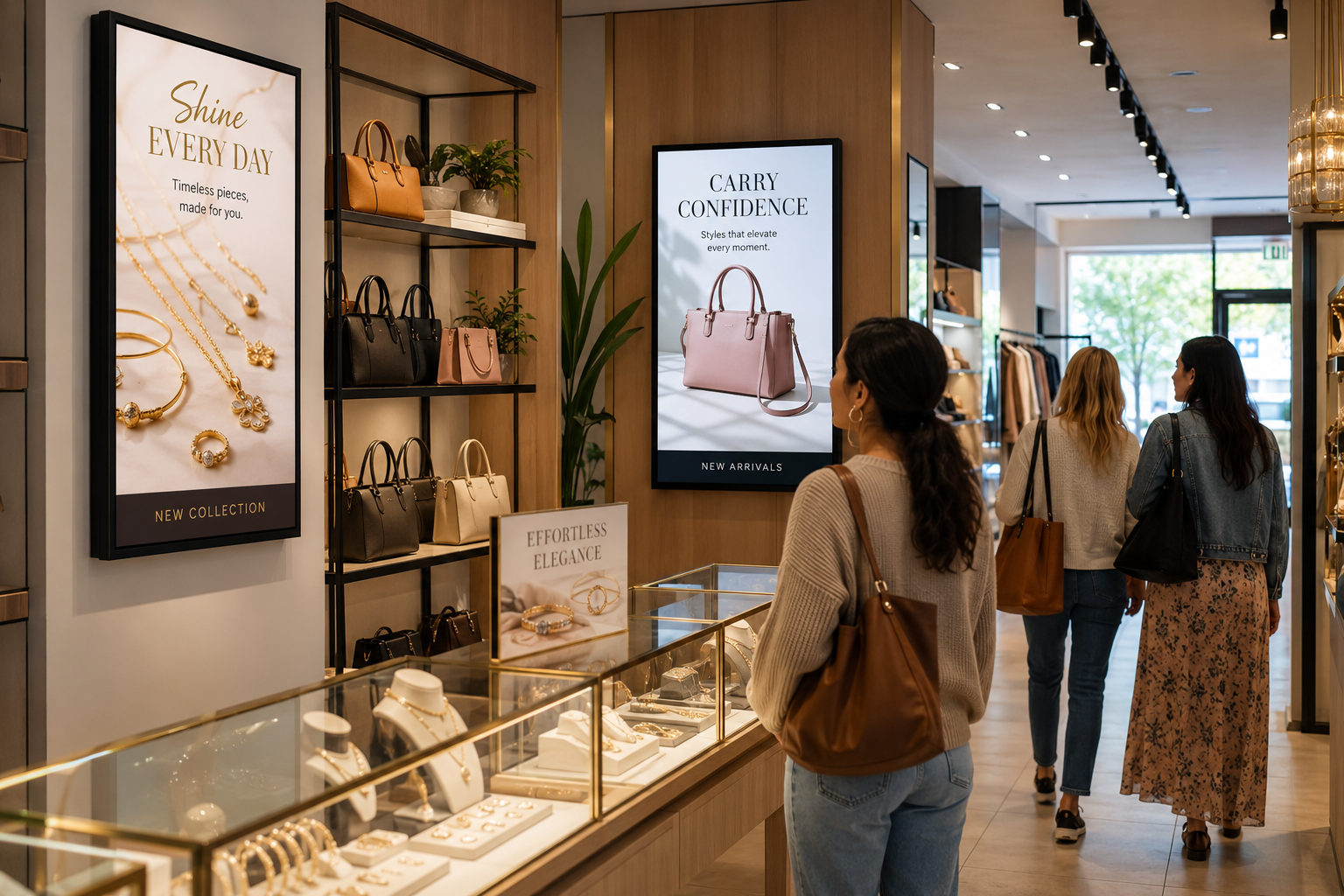
Interactive Fit Guides and Personalization at ScaleBeyond inventory, interactive displays are enabling something even more powerful: personalization at the point of sale. In apparel retail, one of the highest drivers of return rates — and the friction that causes shoppers to default to trying something in-store rather than buying online — is uncertainty about fit. Interactive fit guides, powered by touch screen kiosks equipped with measurement tools or guided questionnaires, help customers identify the right size, cut, and style for their body type before they ever enter a fitting room. Brands like Nordstrom have been piloting this kind of technology at their flagship locations with strong results, but the opportunity is far from limited to department store scale. Boutique retailers in Bellevue's retail corridors and Seattle's Capitol Hill are increasingly deploying compact, stylish kiosks that serve this exact function — reducing return rates, increasing shopper confidence, and shortening the path to purchase. Salesforce's 2023 State of the Connected Customer report found that 73% of consumers expect companies to understand their unique needs and expectations — and that number is rising year over year.⁴ A personalized fit guide isn't a luxury feature. It's table stakes for premium retail positioning.
Capturing the Attention of Seattle's Tech-Savvy ShopperThere's a reason why technology companies have long understood the power of in-person experience. Apple Stores don't exist because Apple needs physical locations to sell phones. They exist because the in-store experience builds a relationship that digital alone cannot. Seattle's consumer base — dense with software engineers, startup founders, UX designers, and early adopters — brings that same sensibility to retail. They are experience-forward consumers who intuitively recognize when a brand has invested in thoughtful, elevated design. And increasingly, interactive technology is part of what signals that investment. A well-executed touch screen experience in a Fremont boutique or a South Lake Union pop-up doesn't just help customers find what they're looking for. It communicates brand values: forward-thinking, customer-centric, premium. It generates social content. It creates moments worth sharing. Google's research on the "zero moment of truth" has long established that today's purchase journey involves an average of 10.4 digital touchpoints before a buying decision is made.⁵ In-store interactive displays extend that digital engagement into the physical environment — reinforcing purchase confidence exactly when and where it matters most.
Beyond Kiosks: Wayfinding, Digital Signage, and the Full In-Store EcosystemInteractive touch screens aren't a single product category — they're an ecosystem. And for Seattle retailers operating across multiple locations or larger footprints, the applications extend well beyond a single product catalog kiosk. Wayfinding systems guide shoppers through multi-floor retail environments or large mixed-use developments, reducing friction and increasing dwell time in high-margin areas. Digital signage allows retailers to update promotions, seasonal messaging, and featured product stories in real time — without the cost and lead time of traditional print production. Interactive windows turn after-hours storefronts into 24/7 engagement tools. For property managers and CRE developers activating retail space in mixed-use developments across the Seattle metro — from Bellevue Square-adjacent boutiques to South Lake Union ground-floor tenants — these technologies are increasingly part of what premium tenants expect and what premium properties deliver. The JLL 2023 Global Real Estate Outlook noted that tech-enabled retail environments are among the top factors driving tenant selection decisions in Class A mixed-use properties.⁶ Developers who invest in the infrastructure to support interactive retail technology are positioning their properties — and their tenants — for long-term relevance.
The ROI Case: What Seattle Retailers Are Actually SeeingLet's talk about the numbers, because the business case for interactive display investment is increasingly well-documented. A Deloitte Digital study found that digital interactions influence 56 cents of every dollar spent in physical retail stores — representing $2.1 trillion in retail sales.⁷ For a retailer generating $1.5M in annual in-store revenue, that means digital influence is touching roughly $840,000 of that figure. The question isn't whether technology is affecting purchasing decisions. The question is whether the retailer is positioned to capitalize on that influence — or cede it to competitors who are. Interactive touch screen deployments typically deliver measurable impact across three dimensions: Revenue lift through higher conversion on extended inventory, upsell and cross-sell surfacing, and reduced walk-aways on out-of-stock items. Operational efficiency through reduced staff burden on common information requests — product availability, sizing guidance, store navigation — freeing associates to focus on high-value engagement. Data intelligence through interaction analytics that reveal what shoppers are browsing, where they're spending time, and what content is driving the most engagement — insights that can inform merchandising, marketing, and inventory decisions. For a boutique retailer in a competitive Seattle neighborhood, these aren't abstract benefits. They translate directly to margin, loyalty, and long-term viability.
What Thoughtful Implementation Looks LikeThe retailers and property teams seeing the strongest returns from interactive display technology share a common approach: they treat it as a strategic investment in the customer experience, not a standalone tech purchase. That means starting with the customer journey. Where does friction currently exist? Where does a shopper need more information than a static display can provide? Where does the physical environment create an opportunity for a moment of delight or discovery? The answers to those questions define where interactive technology creates the most value. It also means working with an implementation partner who understands both the hardware and the experience design — because a technically excellent kiosk that isn't intuitive, well-placed, or visually integrated into the store environment will underperform regardless of its capabilities. At ITS, Inc., this is the approach we bring to every retail engagement. We've helped retailers, property developers, and facility managers across the country — including projects serving major healthcare systems and commercial real estate portfolios in markets like Chicago and New York — design, deploy, and optimize interactive touch screen environments that perform. We don't sell screens. We build experiences.
Seattle Is Ready. Is Your Store?The window to differentiate through in-store technology is still open — but it's narrowing. As more retailers in Capitol Hill, Bellevue, Fremont, and South Lake Union invest in interactive experiences, the baseline consumer expectation will shift. The boutiques that move now will define the new standard. Those that move later will be catching up to it. The good news: getting started doesn't require a complete store redesign or a massive capital outlay. The right partner can help identify the highest-impact touchpoints, design a solution that fits the space and the brand, and build a deployment plan that scales with growth. Seattle's shoppers are already expecting more. The technology to deliver it is here, proven, and ready to deploy.
Ready to Elevate Your In-Store Experience?ITS, Inc. is a national leader in interactive touch screen solutions, with headquarters in Columbia, MD and a New York location serving clients across the country. We partner with retailers, CRE developers, and property managers to design and deploy interactive experiences that drive measurable results. Let's talk about what's possible for your space.
Sources
Frequently Asked QuestionsWhat is an interactive touch screen solution and how does it work in a retail environment? An interactive touch screen solution is a digital display system — ranging from freestanding kiosks to wall-mounted panels and interactive windows — that allows shoppers to engage with content, browse products, access information, and complete actions like placing orders or requesting assistance, all through a touch-enabled interface. In a retail environment, these systems connect to a store's product catalog, inventory management system, and sometimes CRM or loyalty platform, creating a seamless bridge between the physical store and the full digital breadth of a brand's offerings. How do endless aisle kiosks help small and mid-size retailers compete? Endless aisle kiosks eliminate one of the most significant constraints facing smaller retailers: limited floor space and inventory capacity. Rather than losing a sale when a product is out of stock or unavailable in a specific size or colorway, a retailer can direct the shopper to a kiosk where the full catalog is accessible and an order can be placed on the spot. This effectively turns a 1,200 square foot boutique into a storefront with unlimited virtual inventory — without requiring additional warehouse space, staff, or operational overhead. Are interactive displays a good fit for independent boutiques, or are they primarily for large retailers? Interactive touch screen solutions are highly scalable and work exceptionally well for independent boutiques. In fact, smaller retailers often see a proportionally larger impact because the technology levels the playing field — giving a single-location boutique in Capitol Hill or Fremont the kind of digital-physical integration previously available only to national chains with significant technology budgets. Modern deployment models allow independent retailers to start with a single, high-impact touchpoint and expand the ecosystem as the business grows. What is the typical return on investment timeline for an interactive display deployment? Return on investment timelines vary based on deployment size, store traffic volume, and how the technology is integrated into the customer journey. However, retailers who deploy interactive solutions with a clear strategy — focused on high-friction moments like inventory gaps, sizing uncertainty, or wayfinding — typically begin seeing measurable lift within the first 90 days of operation. McKinsey & Company research has shown conversion rate increases of 10–30% on previously unavailable items alone, which for many retailers represents a payback period well under 12 months. How difficult is it to update content and product information on in-store touch screen systems? Modern interactive display platforms are designed for ease of content management. Most operate through cloud-based content management systems (CMS) that allow retailers to update product information, pricing, promotions, and seasonal messaging in real time — often from a smartphone or laptop without any technical expertise required. This means a retailer can push a flash sale, update inventory availability, or swap out featured product content across multiple displays simultaneously, with the same ease as updating a social media post. Can interactive touch screens integrate with existing point-of-sale and inventory systems? Yes. One of the core strengths of enterprise-grade interactive touch screen solutions is their ability to integrate with existing retail technology infrastructure — including point-of-sale platforms, inventory management systems, e-commerce backends, and customer loyalty programs. A well-implemented system creates a unified data environment where in-store interactions feed back into the retailer's broader understanding of customer behavior, and inventory accuracy flows seamlessly from the back end to the customer-facing display. What role do interactive displays play in a mixed-use commercial real estate development? For CRE developers and property managers, interactive technology serves multiple functions in a mixed-use environment. At the property level, wayfinding systems help tenants and visitors navigate complex, multi-floor, or multi-building developments — reducing friction and increasing dwell time in retail and dining areas. At the tenant level, interactive displays enhance the individual store experience and signal to prospective premium tenants that the property is equipped to support tech-forward retail operations. Increasingly, Class A mixed-use developments are treating interactive technology infrastructure as a core amenity alongside high-speed connectivity and flexible floor plates. How does ITS, Inc. support retailers and property teams through the implementation process? ITS, Inc. approaches every engagement as a strategic partnership, not a product transaction. From the initial discovery phase — where we map the customer journey and identify the highest-impact touchpoints — through design, hardware selection, software integration, installation, and ongoing support, our team is involved at every stage. We bring experience across retail, healthcare, commercial real estate, and institutional environments, which means we understand both the technical requirements and the operational realities of deploying interactive technology in complex, high-traffic spaces. Our goal is always to build a solution that performs on day one and scales with the client's growth.
Contact us today to learn more about Navigo® for your property.  |

7150 Columbia Gateway Drive, Suite L, Columbia, MD 21046
112 West 34th Street, 18th floor, Room 18025 New York, NY 10001
Proud Member

7150 Columbia Gateway Drive, Suite L
Columbia, MD 21046
112 West 34th Street, 18-025
New York, NY 10001
