

Headquarters
7150 Columbia Gateway Drive, Suite L, Columbia, MD 21046
New York Location
112 West 34th Street, 18th floor, Room 18025 New York, NY 10001
Proud Member


Rain or Shine: Ruggedized Outdoor Touch Screen Solutions for the Pacific Northwest2 minute read | Updated June 19, 2026
The Pacific Northwest has a complicated relationship with the outdoors. On one hand, the region's residents are among the most outdoors-oriented in the country — hiking, cycling, kayaking, and generally refusing to let weather dictate whether life happens outside. On the other hand, the Pacific Northwest's weather is genuinely demanding: persistent rain from October through May, temperatures that swing from near-freezing to occasionally scorching, coastal fog and humidity that would destroy conventional electronics within a season, and the particular atmospheric phenomenon that locals call "partly cloudy" and visitors call "overcast for four straight months." For businesses, municipalities, transit authorities, and property developers who want to deploy interactive touch screen technology in outdoor environments across Washington and Oregon, that weather reality is not a minor consideration. It is the central design constraint — the factor that separates a successful outdoor technology deployment from an expensive maintenance problem. The good news is that the technology has caught up with the climate. A new generation of ruggedized, weatherproof, outdoor-rated interactive touch screen systems is designed specifically for demanding environmental conditions — built to IP67 and IP65 ingress protection standards, engineered with anti-glare display technology that performs in the Pacific Northwest's characteristic flat, overcast light, equipped with smart thermal management systems that maintain optimal operating temperatures across the region's seasonal temperature range, and constructed with materials that resist the corrosive effects of coastal moisture and urban pollution. For the municipalities investing in smart city infrastructure along Seattle's waterfront and Portland's transit corridors, the hospitality operators equipping outdoor dining patios with interactive ordering and entertainment systems, the transit authorities modernizing bus stops and ferry terminals across the Puget Sound and Willamette Valley regions, and the CRE developers activating outdoor public spaces in mixed-use developments from Bellevue to the Pearl District, this technology represents a genuine opportunity to extend the reach and impact of interactive digital infrastructure into environments that have historically been off-limits.
Understanding IP Ratings: The Foundation of Outdoor Technology DeploymentAny serious conversation about outdoor touch screen technology in the Pacific Northwest begins with IP ratings — the Ingress Protection classification system established by the International Electrotechnical Commission (IEC) that defines the degree to which an enclosure protects its contents against the intrusion of solid particles and liquids. The IP rating system uses a two-digit code in which the first digit (0–6) indicates protection against solid particle ingress and the second digit (0–9) indicates protection against liquid ingress. For Pacific Northwest outdoor deployments, the relevant ratings are: IP65 — fully protected against dust ingress and against water projected from a nozzle in any direction. This is the minimum standard for outdoor deployments in environments with rain exposure, and is appropriate for sheltered outdoor installations where direct water pressure is limited — covered transit stops, outdoor dining areas with overhead protection, or building facade installations with significant overhang. IP66 — fully dust-protected and protected against powerful water jets from any direction. Appropriate for more exposed outdoor installations where wind-driven rain may create significant water pressure against enclosure surfaces — open plazas, waterfront locations, or installations without overhead shelter. IP67 — fully dust-protected and protected against temporary immersion in water up to one meter for 30 minutes. The standard most often specified for Pacific Northwest outdoor deployments in exposed locations, providing confidence against even the most significant rain events the region produces. IP68 — fully dust-protected and protected against continuous immersion beyond one meter. Typically specified for marine or waterfront installations where wave action or tidal flooding is a realistic risk — ferry terminals, waterfront park installations, or coastal retail and hospitality environments. The IEC's IEC 60529 standard defines these classifications and the testing procedures that validate them.¹ For procurement teams at Seattle's Office of the Waterfront, TriMet's capital infrastructure program, or the property management teams overseeing mixed-use developments in Portland's Pearl District, specifying the appropriate IP rating for each outdoor installation is a foundational decision that determines long-term reliability and total cost of ownership. Beyond IP rating, outdoor enclosures for Pacific Northwest deployments should meet NEMA 4X standards — the National Electrical Manufacturers Association classification for enclosures that provide protection against corrosion, windblown dust and rain, splashing water, and hose-directed water. NEMA 4X is the standard most commonly required by municipal procurement programs and public infrastructure contracts in Washington and Oregon, and aligns closely with IP66 liquid ingress protection while adding specific requirements for corrosion resistance — particularly relevant in Seattle's maritime climate and Portland's urban air quality environment.²
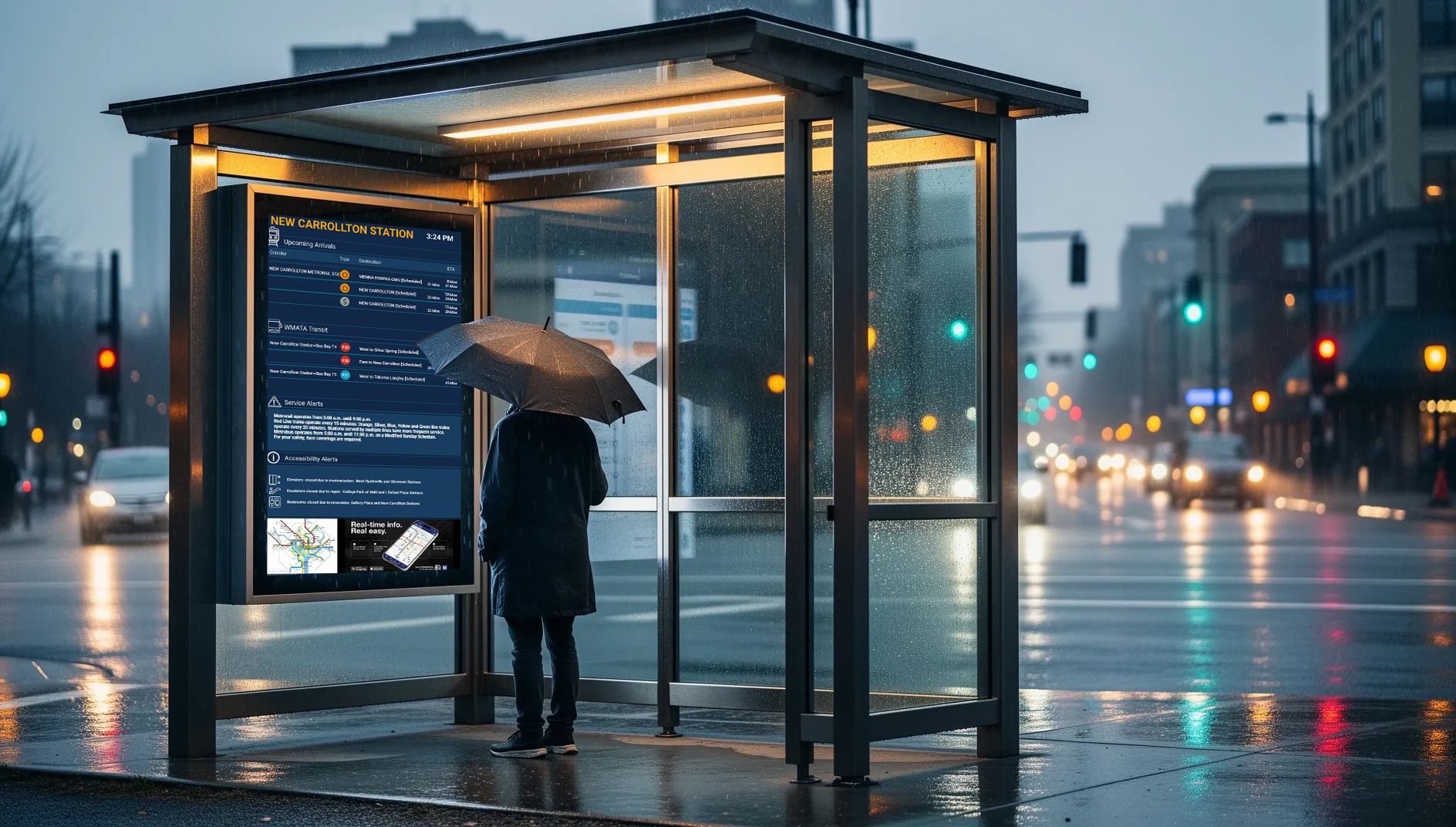
Anti-Glare Technology in the PNW's Overcast Light EnvironmentOne of the less intuitive challenges of outdoor display technology in the Pacific Northwest is the anti-glare requirement — and understanding why it matters requires a moment's consideration of the region's particular light environment. Many people assume that anti-glare technology is primarily a concern in sunny climates, where direct sunlight creates obvious reflections on display surfaces. In the Pacific Northwest, the challenge is actually more complex. The region's characteristic overcast sky acts as a massive, diffuse light source — producing ambient light levels that are lower than direct sunlight but that create reflections across the entire display surface rather than at a single angle. The result is a consistent, uniform glare that can make standard display surfaces difficult to read across a wide range of viewing angles — particularly problematic in public-facing deployments where viewers approach from multiple directions and cannot adjust their position relative to the screen. Optical bonding is the technology that most effectively addresses this challenge in outdoor display applications. By eliminating the air gap between the display's protective glass and its LCD or LED panel — replacing it with a layer of optically clear adhesive — bonded displays eliminate the internal reflection that occurs when light passes between materials with different refractive indices. The result is a display that maintains contrast and readability across a much wider range of ambient light conditions than an unbonded display, with typical reflectance reductions of 50–70% compared to standard glass-over-display configurations.³ High-brightness display technology complements optical bonding by increasing the display's output luminance — measured in nits — to a level that maintains visual contrast even in high ambient light conditions. Standard indoor displays typically operate at 250–400 nits. Outdoor displays designed for PNW conditions typically specify 1,000–2,500 nits for sheltered or semi-sheltered installations, with 3,000–5,000 nit displays used for fully exposed deployments where ambient light levels are highest. For Seattle's waterfront installations along the Elliott Bay Trail, Portland's outdoor kiosks along the Tom McCall Waterfront Park, or transit information displays at the region's exposed bus rapid transit stations, the combination of optical bonding and high-brightness display technology is what separates a system that passengers and visitors can actually use from one that produces a beautiful glowing rectangle that nobody can read.
Smart Thermal Management: Performing Across the PNW's Temperature RangeThe Pacific Northwest's temperature range presents a different thermal management challenge than either cold-climate or hot-climate deployments — and it is one that generic outdoor technology specifications frequently underestimate. The region's coastal and valley climates experience relatively moderate absolute temperatures — Seattle's average January low is approximately 36°F, and its average July high is approximately 77°F — but the combination of high humidity, persistent moisture, and occasional temperature extremes at the margins of this range creates a thermal environment that demands careful management. At the low end, near-freezing temperatures combined with high humidity can create condensation within display enclosures — potentially affecting display performance, creating safety hazards around electrical components, and accelerating corrosion of metal components. Thermostatically controlled heating elements within the display enclosure maintain interior temperatures above the condensation threshold even in the coldest Pacific Northwest conditions, ensuring consistent startup performance and preventing moisture accumulation that degrades long-term reliability. At the high end, the Pacific Northwest's increasingly common summer heat events — Seattle and Portland both recorded all-time temperature records in the 2021 heat dome event, with temperatures exceeding 100°F in both cities — can push outdoor display enclosures well beyond the operating temperature thresholds of standard commercial displays. Active cooling systems, including thermostatically controlled fans and, for the highest-specification deployments, Peltier cooling elements or refrigerant-based cooling modules, maintain interior temperatures within the display's safe operating range during these extreme events. The thermal management system must also address the operational reality that Pacific Northwest outdoor displays often experience rapid temperature transitions — moving from a cold, damp morning through a warm, occasionally sunny afternoon and back to cool, humid evening conditions within a single operational day. Intelligent thermal management controllers that monitor both interior and exterior temperatures and adjust heating and cooling outputs dynamically are far more effective than fixed setpoint systems — maintaining consistent operating conditions across the full diurnal temperature cycle while consuming the minimum energy required to do so. The American Society of Heating, Refrigerating and Air-Conditioning Engineers (ASHRAE) publishes guidelines for electronic equipment thermal management in outdoor enclosures that inform the design specifications of leading outdoor display systems.⁴ For procurement teams specifying outdoor touch screen systems for Pacific Northwest deployments, validating that proposed hardware meets ASHRAE thermal management guidelines for the expected operating temperature range is an important component of due diligence.
Outdoor Dining and Hospitality: Technology That Works on the PatioPortland and Seattle's restaurant and hospitality scenes have embraced outdoor dining with an enthusiasm that defies the climate — and the technology opportunities in these environments are significant. Outdoor dining patios represent one of the most commercially compelling deployment contexts for weatherproof touch screen technology in the Pacific Northwest. Interactive table-side ordering terminals allow guests at outdoor venues to browse menus, customize orders, and request service without waiting for a server to navigate a busy patio — improving order accuracy, increasing average check size through on-screen upsell prompts, and reducing the pressure on service staff during peak outdoor dining periods. Weatherproof digital menu boards allow restaurants and bars to update their outdoor menu displays in real time — reflecting daily specials, seasonal menu changes, happy hour pricing, and sold-out items without requiring staff to update chalkboards or swap printed menus in the rain. For Portland's outdoor dining culture — where patrons happily occupy patio heater-equipped spaces in conditions that would drive most cities indoors — the ability to present a premium, fully current menu experience in an outdoor environment is a meaningful differentiator. For the CRE developers and property managers activating outdoor retail and dining spaces in mixed-use developments — the ground-floor patios of South Lake Union's tech campuses, the activated plazas of Portland's Pearl District developments, the waterfront dining corridors of Seattle's Capitol Waterfront — weatherproof interactive display technology is increasingly part of the amenity programming that premium tenants expect and that competitive properties deliver. The National Restaurant Association's 2023 Outdoor Dining Technology Report found that restaurants deploying interactive ordering technology in outdoor settings saw an average 22% increase in outdoor seat revenue during deployment periods, driven by higher order frequency, increased average check, and extended guest dwell time.⁵ For operators who have invested significantly in outdoor dining infrastructure — heating systems, weather protection, premium furniture — technology that extracts more revenue from those seats during operational hours is a natural complement to that investment.
Transit and Municipal Applications: Smart City Infrastructure for the PNWThe Pacific Northwest's major transit authorities — King County Metro, Sound Transit, TriMet, Community Transit, and the Washington State Ferries system — operate in exactly the outdoor conditions that ruggedized touch screen technology is designed for. Bus stops, ferry terminals, light rail stations, and transit centers are outdoor or semi-outdoor environments where passengers need real-time information, wayfinding assistance, and ticketing access regardless of whether it's a clear July morning or a February morning of sideways rain. Interactive transit information kiosks at Seattle and Portland bus rapid transit stations provide passengers with real-time arrival information, route planning tools, fare payment interfaces, and system maps — all through a weatherproof, high-brightness touch interface that performs reliably in the region's full range of weather conditions. For Sound Transit's expanding Link light rail network and TriMet's MAX light rail system, interactive kiosks at station entrances serve the dual function of reducing fare evasion through accessible ticketing and improving the passenger experience for the growing ridership these systems are serving. Washington State Ferries — the largest ferry system in the United States, carrying approximately 24 million passengers annually across Puget Sound — operates in one of the most demanding outdoor technology environments imaginable: salt air, constant moisture, wind, and the physical vibration of vessel operation.⁶ Weatherproof touch screen kiosks at ferry terminals in Edmonds, Kingston, Mukilteo, Clinton, and the Seattle Colman Dock provide passengers with ticketing, scheduling, and wayfinding access in a genuinely maritime environment — requiring IP68 ratings, corrosion-resistant enclosure materials, and thermal management systems engineered for the specific challenges of coastal marine exposure. For municipal planners and transit authorities making capital investment decisions about outdoor interactive infrastructure, the total cost of ownership calculation is critical. A lower-specification outdoor display that requires frequent service, suffers weather-related failures, or needs replacement within three to four years of installation is not a cost-effective solution regardless of its lower initial purchase price. The lifecycle cost advantage of properly specified, ruggedized outdoor displays — with 7–10 year operational lifespans in Pacific Northwest conditions when correctly specified — consistently justifies the premium over lower-specification alternatives when modeled across a realistic deployment horizon.
Parks, Public Spaces, and the Smart City OpportunityBeyond transit and hospitality, Western Washington and Oregon's municipalities are increasingly exploring the role of outdoor interactive technology in parks, public plazas, and civic spaces — as part of broader smart city infrastructure programs that use technology to enhance the public realm and improve citizen engagement with city services. Seattle's Seattle Department of Transportation and Seattle Parks and Recreation department have both explored interactive public information systems as part of the city's smart city initiatives — providing park visitors, cyclists, and pedestrians with wayfinding information, event schedules, safety alerts, and access to city services through outdoor touch screen interfaces deployed in high-traffic public spaces. Portland's Bureau of Transportation and Portland Parks & Recreation operate within a similar framework, with the city's sustainability commitments adding an additional dimension to outdoor technology deployments: solar-powered outdoor kiosks that operate independently of grid infrastructure, reducing both operational costs and carbon footprint, are an increasingly attractive option for Portland's park and public space applications. Solar-powered outdoor kiosk systems combine photovoltaic panels — sized for the Pacific Northwest's solar irradiance profile, which is lower than sunnier climates but sufficient for well-designed low-power systems — with battery storage that maintains operational capability through cloudy periods and overnight hours. For park and public space deployments where trenching electrical conduit would be disruptive or cost-prohibitive, solar-powered systems dramatically expand the potential installation footprint and align naturally with the sustainability values of Pacific Northwest municipal operators. The Smart Cities Council's 2023 Outdoor Digital Infrastructure Report found that municipalities deploying outdoor interactive information systems in parks and public spaces reported measurable improvements in visitor satisfaction, increased utilization of park amenities, and reduced burden on parks staff for routine information requests — outcomes that align directly with the operational priorities of Seattle and Portland's parks departments operating under budget constraints and rising visitation volumes.⁷
Specifying the Right Outdoor System: A Practical FrameworkFor procurement teams, property managers, transit planners, and municipal technology officers specifying outdoor touch screen systems for Pacific Northwest deployments, a practical specification framework includes the following key dimensions. Ingress protection should be specified at IP67 minimum for all exposed outdoor installations in Western Washington and Oregon, with IP68 required for marine and waterfront environments. NEMA 4X enclosure rating should be required for all municipal and transit procurements. Display brightness should be specified at a minimum of 1,500 nits for sheltered outdoor installations and 2,500 nits or greater for fully exposed deployments. Optical bonding should be standard across all outdoor display specifications to address the Pacific Northwest's diffuse overcast light environment. Operating temperature range should be validated against the deployment location's historical temperature extremes — including the 100°F+ events that the region now experiences periodically — with active thermal management systems required for any deployment where enclosure interior temperatures could exceed the display's rated operating range. Vandal resistance is a practical requirement for public-facing outdoor installations, particularly in high-traffic urban environments. IK10-rated enclosures — the highest level of impact protection under the IEC 62262 standard — provide protection against deliberate impact equivalent to 20 joules, appropriate for transit stations, urban plazas, and public park deployments.⁸ Connectivity and remote management capabilities are essential for outdoor deployments where physical service access is difficult or disruptive. Remote monitoring, content management, and diagnostic capabilities allow operators to manage display networks, update content, and identify performance issues without requiring on-site intervention for routine management tasks.
Ready to Take Your Technology Outdoors?ITS, Inc. partners with Pacific Northwest municipalities, transit authorities, hospitality operators, and CRE developers to design and deploy ruggedized outdoor touch screen solutions built for the region's demanding climate. Whether you're equipping a Seattle waterfront transit stop, activating a Portland outdoor dining patio, or deploying smart city infrastructure in a public park, we bring the specification expertise, hardware relationships, and implementation experience to ensure your outdoor technology investment performs — rain or shine.
Sources
Frequently Asked QuestionsWhat IP rating do I need for an outdoor kiosk installation in Seattle or Portland? For most exposed outdoor installations in Western Washington and Oregon, IP67 is the appropriate minimum specification — providing protection against dust ingress and temporary water immersion that covers the rain exposure and occasional flooding risk of Pacific Northwest outdoor environments. Marine and waterfront installations, including ferry terminals and waterfront park deployments, should specify IP68. Sheltered installations with overhead protection and limited direct rain exposure may be adequately served by IP65, though IP67 is generally recommended for any installation where weather exposure cannot be fully controlled. How does anti-glare technology work in the Pacific Northwest's overcast light conditions? The Pacific Northwest's overcast sky creates a diffuse, wide-angle ambient light environment that produces reflections across the entire display surface rather than at a single point. Optical bonding — which eliminates the air gap between the protective glass and the display panel — reduces internal reflectance by 50–70% compared to standard glass-over-display configurations, dramatically improving readability in overcast conditions. High-brightness display technology (1,500–5,000 nits depending on installation type) provides additional contrast headroom against ambient light levels. Can outdoor touch screens handle the Pacific Northwest's temperature extremes, including summer heat events? Yes, when properly specified. Smart thermal management systems — including thermostatically controlled heating elements for cold weather condensation prevention and active cooling systems for high-temperature events — maintain interior display temperatures within safe operating ranges across the full seasonal temperature range of the Pacific Northwest, including the 100°F+ heat dome events the region has experienced in recent years. ITS, Inc. validates thermal management specifications against historical temperature data for each deployment location. Are solar-powered outdoor kiosks viable in the Pacific Northwest's low-solar-irradiance environment? Yes, with appropriate system design. The Pacific Northwest's solar irradiance is lower than sunnier climates, but well-designed solar-powered kiosk systems — using high-efficiency photovoltaic panels sized for the region's irradiance profile and appropriately sized battery storage — can maintain reliable operation through cloudy periods and overnight. Solar-powered systems are particularly well-suited to Portland and Seattle parks and public space deployments where grid power access is limited or disruptive to install. What vandal resistance standards should be specified for public outdoor deployments? IK10 — the highest rating under IEC 62262 — provides protection against deliberate impact equivalent to 20 joules and is the appropriate specification for transit stations, urban plazas, and public park deployments in Washington and Oregon. ITS, Inc. specifies IK10-rated enclosures as standard for all public-facing outdoor installations and can provide documentation of impact resistance testing for procurement and compliance purposes. How does ITS, Inc. approach outdoor deployments in the Pacific Northwest's specific climate conditions? ITS, Inc. brings direct experience deploying outdoor interactive technology in demanding climate environments — including maritime, high-humidity, and wide-temperature-range conditions comparable to the Pacific Northwest. We approach every outdoor deployment with a site-specific environmental assessment that identifies the relevant ingress protection, thermal management, display brightness, and vandal resistance requirements for the specific installation location, and we specify hardware that meets those requirements with documented performance validation. Our ongoing support model ensures outdoor deployments continue to perform reliably across their full operational lifespan.
Contact us today to learn more about Navigo® for your property.  |

7150 Columbia Gateway Drive, Suite L, Columbia, MD 21046
112 West 34th Street, 18th floor, Room 18025 New York, NY 10001
Proud Member

7150 Columbia Gateway Drive, Suite L
Columbia, MD 21046
112 West 34th Street, 18-025
New York, NY 10001
