

Headquarters
7150 Columbia Gateway Drive, Suite L, Columbia, MD 21046
New York Location
112 West 34th Street, 18th floor, Room 18025 New York, NY 10001
Proud Member


Jersey City Is Booming — What That Means for Building Technology in the Garden State's Hottest Market2 minute read | Updated May 12, 2026
Jersey City doesn't need to make a case for itself anymore — the market data makes it for them. According to PwC and the Urban Land Institute's Emerging Trends in Real Estate 2026 report, Jersey City ranked second among all U.S. markets to watch for overall real estate prospects, behind only Dallas/Fort Worth. REBusinessOnline That's not a regional accolade. That's a national recognition of a market that has systematically repositioned itself into one of the most compelling destinations for real estate capital in the country. PwC and ULI describe Jersey City as a fast-growing commercial hub whose convenient proximity and connection to New York City enhances its appeal to both startups and established firms alike, with access to top talent, investors, and global markets while maintaining a more affordable and scalable business environment. PwC The numbers reflect that positioning precisely. Average asking rent for office space along the Hudson River waterfront — encompassing Jersey City, Hoboken, and Weehawken — currently sits at $44.51 per square foot, which is 32% above the broader Northern New Jersey average, while still sitting 42% below the Manhattan average. PwC For tenants priced out of Midtown but unwilling to compromise on location, talent access, and building quality, Jersey City represents an increasingly obvious answer. And the residential side of the market tells the same story. Jersey City's overall apartment inventory has expanded by 20% over the past five years REBusinessOnline, and occupancy remains exceptionally tight — a direct reflection of relentless demand from a well-educated, high-income resident base that works in Manhattan but has chosen to build its life across the Hudson.
The Skyline Is Being Rewritten in Real TimeWhat makes Jersey City's moment particularly significant for building owners, developers, and property managers is the sheer scale of what is currently under construction. The development activity underway is not incremental — it is transformational. JLL's Capital Markets group recently secured $384 million in construction financing for Harborside 8, a 65-story, 678-unit luxury waterfront development at 242 Hudson Street, with groundbreaking planned for Q1 2026 and stabilization anticipated by 2030. Resident The project will deliver over 20,000 square feet of amenity space, a redesigned 40,000-square-foot waterfront public park, and ground-floor retail — a mixed-use program that will generate significant daily foot traffic from the moment the building opens. Tishman Speyer has secured $331 million in construction financing for 50 Hudson Street, a 40-story, 924-unit apartment tower on the Gold Coast — the second phase of a two-building project that will ultimately deliver 1,941 apartments and 70,000 square feet of retail space upon completion. Multi-Housing News LeFrak's 47-story 20 Long Slip tower, one of the largest multifamily construction starts in the U.S. in the summer of 2025, is rising within the master-planned Newport neighborhood and will bring 529 units to the waterfront. NJBIZ Further inland, One Journal Square — a dual-tower, 64-story residential project developed by Kushner Companies — is expected to deliver 1,723 apartments and over 41,000 square feet of retail space BLDUP, cementing Journal Square's emergence as a secondary hub within the broader Jersey City market. Each of these projects is a large-scale, mixed-use environment designed to attract premium tenants and residents. And each one presents a defining question for the development and property management teams behind them: does your building technology infrastructure match the ambition of the building itself?
High Density Creates High Complexity — and High ExpectationsA single-tenant suburban office building and a 65-story mixed-use tower in Jersey City are fundamentally different operational environments. The difference isn't just scale — it's complexity, flow, and the daily experience of hundreds or thousands of people moving through the same building. In a high-density mixed-use environment, consider the daily reality. Corporate office tenants are welcoming clients, vendors, and job candidates. Residential floors have their own visitor traffic, delivery flows, and service needs. Ground-floor retail generates its own stream of foot traffic that intersects with every other building population. Commuters moving to and from PATH stations and ferry terminals are flowing through lobbies and ground-level spaces throughout the day. Building staff are managing all of this simultaneously, across multiple uses and multiple access points. Without enterprise-grade building technology — wayfinding, visitor credentialing, digital directories, and real-time communication systems — that complexity becomes friction. And friction, in a market where tenants and residents have choices, is a competitive liability.
Enterprise-Grade Wayfinding Is No Longer OptionalIn a large mixed-use tower or campus environment, the question of "how do I get where I'm going?" is asked dozens of times a day by visitors, vendors, residents, and tenants unfamiliar with the building. The answer to that question — whether seamless and immediate or frustrating and unclear — shapes the experience of everyone in the building. Enterprise-grade interactive wayfinding systems, like those powered by Navigo®, give building operators the ability to deploy dynamic, real-time directory and navigation experiences across lobby kiosks, elevator lobbies, digital signage, and multi-building campuses. Rather than static printed directories that become outdated the moment a tenant moves, interactive systems allow building managers to update tenant information, floor maps, and directional content instantly, from a central platform. For Jersey City's emerging generation of mixed-use properties — buildings with dozens of commercial tenants, hundreds of residential units, and thousands of daily visitors — this level of infrastructure is the standard that premium positioning demands. Finance, insurance, and real estate sector firms have accounted for 63% of all leasing activity in Jersey City from 2022 to 2025 PwC — a tenant profile that brings high client volume, regulatory sensitivity, and an expectation of operational excellence in every building system they interact with.
Visitor Credentialing at ScaleThe nature of visitor management in a high-density mixed-use building is categorically different from that of a smaller suburban property. In a Jersey City waterfront tower housing multiple financial services firms, a credentialed visitor check-in system isn't a convenience — it's a security requirement and a professional baseline. Modern visitor credentialing systems go well beyond signing a paper log at a reception desk. They enable pre-registration, digital badge issuance, instant notification to the tenant being visited, and a complete audit trail of building access — all without creating bottlenecks at the lobby level. For buildings with multiple tenant suites and a high volume of external visitors, this capability is what keeps the lobby experience moving efficiently while meeting the access control standards that corporate tenants increasingly require as a condition of their lease. What people experience when they enter a connected building today feels natural: seamless access, personalized environments, faster movement through lobbies, and spaces that adapt throughout the day. Cohesionib In Jersey City's most competitive buildings, that standard is already the expectation. The buildings that haven't invested in this layer of technology are increasingly visible by contrast.
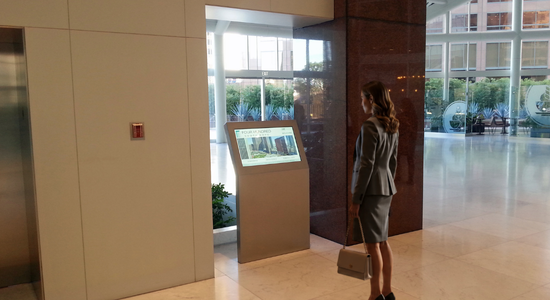
Digital Directories in Multi-Tenant EnvironmentsOne of the most visible and immediately impactful technology investments a multi-tenant building can make is the deployment of interactive digital directory systems in its lobby. In Jersey City's high-rise office and mixed-use environment, where a single building may house dozens of commercial tenants across fifty or more floors, the lobby directory is a critical daily-use asset. Interactive touchscreen directories powered by Navigo® deliver far more than a list of tenant names. They provide floor-by-floor wayfinding, integrate with building access and visitor management systems, support real-time updates as tenants change, and create a branded lobby experience that signals the quality of the asset from the moment someone walks through the door. For a development competing for the attention of financial services firms, technology companies, and the kind of premium resident base that Jersey City's waterfront commands, the lobby moment carries real weight. A polished, responsive digital directory tells a prospective tenant everything they need to know about how the building is managed — before they've spoken to a single person.
The Technology Infrastructure of Tomorrow's Buildings, Deployed TodayJersey City's development pipeline is a front-row seat to what the next generation of premium commercial real estate looks like. The projects now under construction — Harborside 8, 50 Hudson, One Journal Square, and dozens of others reshaping the skyline — are being designed for the standards of 2028 and beyond. The building technology infrastructure that supports them needs to match that ambition. Northern New Jersey is broadly considered a strong acquisition target, with investors viewing the market as a net buy particularly for multifamily product, while Jersey City's 7.5% population increase between 2020 and 2024 continues to drive demand fundamentals. NJBIZ As capital continues to flow into Jersey City and its surrounding submarkets, the properties that will capture premium tenants, command top-of-market rents, and sustain occupancy through market cycles are the ones that have invested in the full stack — including the operational and experiential technology layer that makes a building genuinely exceptional to occupy. The buildings winning in Jersey City aren't just taller. They're smarter.
Ready to Build Smarter in Jersey City?Interactive Touchscreen Solutions, Inc. (ITS, Inc.) powered by Navigo® works with developers, building owners, and property managers across the tri-state area to deploy enterprise-grade digital directory, wayfinding, and visitor management systems that match the demands of today's most competitive mixed-use environments. If you're bringing a new development to market — or repositioning an existing asset in Jersey City or anywhere across the Garden State — Interactive Touchscreen Solutions, Inc. powered by Navigo® is ready to be your building technology partner from day one.
Connect with the Interactive Touchscreen Solutions, Inc. powered by Navigo® team to get started
FAQsWhy is Jersey City ranked among the top real estate markets in the country for 2026? Jersey City's ascent to the top tier of national real estate rankings reflects years of deliberate investment in infrastructure, transit connectivity, and mixed-use development that has fundamentally repositioned the city's identity. PwC and ULI's Emerging Trends in Real Estate 2026 report placed Jersey City second among all U.S. markets to watch — a recognition rooted in the city's unique value proposition: Manhattan proximity and talent access at a meaningful cost discount. A 7.5% population increase between 2020 and 2024, a highly educated resident base, and sustained demand from financial services and technology sector tenants have created market fundamentals that are difficult to replicate elsewhere in the Northeast. What types of tenants are driving office leasing demand in Jersey City? Jersey City's office leasing market has a clearly defined center of gravity. Finance, insurance, and real estate sector firms have accounted for nearly two-thirds of all leasing activity in the city over the past several years, drawn by the waterfront's premium office product, its direct PATH and ferry access to Lower Manhattan, and asking rents that remain substantially below comparable Manhattan space. Technology companies and professional services firms round out the demand picture, particularly in submarkets like Journal Square that are attracting a younger, growth-oriented tenant profile. Across all of these categories, the common thread is a tenant base with high expectations for building quality, operational efficiency, and the professional environment their employees and clients will experience. How does the scale of Jersey City's development pipeline affect building technology requirements? The scale of what is currently under construction in Jersey City creates building management challenges that simply don't exist in smaller or less complex environments. When a single asset houses dozens of commercial tenants across fifty or more floors, hundreds of residential units, ground-floor retail, and a constant flow of visitors and commuters, the operational demands on building technology are categorically different from a suburban office park. Wayfinding, visitor credentialing, digital directories, and real-time communication systems aren't amenity upgrades in this context — they are core infrastructure. The buildings rising along the waterfront and in Journal Square right now are being designed for a future where enterprise-grade technology is the baseline, not a differentiator. What is enterprise-grade wayfinding and why does it matter in a mixed-use building? Enterprise-grade wayfinding refers to interactive, centrally managed navigation and directory systems that can support the complexity of a large multi-tenant environment in real time. Unlike static printed directories or basic digital signage, enterprise wayfinding systems allow property managers to update tenant information, floor maps, and directional content instantly from a central platform — across lobby kiosks, elevator lobbies, and digital signage throughout the building. In a mixed-use tower where tenants change, floors get reconfigured, and hundreds of unfamiliar visitors arrive daily, that dynamic capability is what keeps the building operating smoothly. The alternative — outdated directories and confusing navigation — creates friction that reflects poorly on the building and on every tenant inside it. How does visitor credentialing differ between a suburban office building and a Jersey City high-rise? The difference is one of volume, complexity, and professional expectation. In a suburban multi-tenant building, visitor management might mean a sign-in sheet and a phone call to the tenant being visited. In a Jersey City waterfront tower housing multiple financial services firms, that approach is neither sufficient nor appropriate. Enterprise visitor credentialing systems enable pre-registration before arrival, digital badge issuance, instant tenant notification, and a complete audit trail of building access — all processed without creating congestion at the lobby level during peak morning hours. For corporate tenants with regulatory compliance requirements or simply high standards for how their clients are received, a capable visitor management system is increasingly a condition of choosing a building, not an afterthought. What role do digital lobby directories play in the tenant attraction process? The lobby is the first impression a building makes on every prospective tenant, every visiting client, and every new employee on their first day. In Jersey City's competitive leasing environment — where premium tenants have real options across the waterfront and beyond — that impression carries weight. An interactive digital directory signals professional management, current investment, and a building that is operationally serious. It tells a prospective tenant touring the building that the ownership team has thought carefully about the daily experience of the people inside. Beyond the tour, these systems deliver ongoing operational value through real-time updates, wayfinding integration, and a lobby experience that remains polished and functional regardless of tenant turnover. Is building technology infrastructure something that needs to be planned at the development stage, or can it be added to an existing building? Both approaches are viable, but planning for building technology at the development stage creates significantly better outcomes. When digital directory, wayfinding, and visitor management systems are incorporated into a building's design from the beginning, the infrastructure — power, connectivity, mounting, and placement — can be optimized for the specific layout and traffic flows of the property. Retrofitting existing buildings is entirely achievable and is a common path for owners repositioning assets to compete for premium tenants, but it requires more coordination around placement, conduit, and integration with existing access control systems. For developers currently in the design and construction phase of Jersey City projects, now is the right moment to engage with a building technology partner. How does building technology contribute to long-term asset value in a market like Jersey City? Building technology contributes to asset value through two primary mechanisms: rent premium and occupancy stability. Properties that deliver a demonstrably superior operational experience — seamless visitor management, intuitive wayfinding, polished lobby technology — are positioned to command higher rents from tenants who value those features and to retain tenants at renewal because the building consistently delivers on the promise made during the leasing process. In a market like Jersey City, where investor interest is high and the competition for premium tenants is real, the operational and experiential quality of a building is increasingly reflected in its valuation. Smart technology investment is not a cost center — it is a long-term value creation strategy.
Sources: PwC and Urban Land Institute, Emerging Trends in Real Estate 2026; JLL Capital Markets; Multi-Housing News; NJBIZ; RE Business Online; Primior Group Commercial Real Estate 2026; Cohesion IB Smart Building 2026 Outlook.
Contact us today to learn more about Navigo® for your property.  |

7150 Columbia Gateway Drive, Suite L, Columbia, MD 21046
112 West 34th Street, 18th floor, Room 18025 New York, NY 10001
Proud Member

7150 Columbia Gateway Drive, Suite L
Columbia, MD 21046
112 West 34th Street, 18-025
New York, NY 10001
