


Headquarters
7150 Columbia Gateway Drive, Suite L, Columbia, MD 21046
New York Location
112 West 34th Street, 18th floor, Room 18025 New York, NY 10001
Proud Member


Inside Maryland's Life Sciences Building Boom: Why Every New Campus Lobby Needs a Smarter Directory4 minute read | Updated May 7, 2026
Maryland's I-270 corridor has carried the nickname "DNA Alley" since Time magazine coined it in 2000 to describe what it called one of the world's largest and smartest concentrations of genomic firms. That stretch runs from Bethesda through Rockville, Gaithersburg, Germantown, Clarksburg, and up to Frederick — home to a collection of life sciences businesses spanning startups to established global leaders including GlaxoSmithKline and AstraZeneca. Milrose More than two decades later, the corridor hasn't slowed down. It has accelerated. Montgomery County alone anchors the BioHealth Capital Region and is home to more than 300 life sciences companies specializing in immunology, cell and gene therapy, biopharmaceuticals, and R&D manufacturing — employing roughly 26,000 workers, or 65% of Maryland's total biotech workforce. Last year alone, $820 million was invested in Montgomery County life sciences companies. Thinkmoco The scale of new construction coming online reflects that momentum directly. Three landmark projects are reshaping what life sciences real estate looks like in Maryland — and each one raises a question that every developer, landlord, and tenant in the region should be asking: when this building opens, what does the lobby say about what's inside?
The Projects Defining Maryland's Life Sciences MomentThe Belward Campus, Shady Grove The Belward Campus of The Johns Hopkins University will be Maryland's largest life sciences campus — a world-class work environment spanning over 1.5 million square feet across seven trophy lab and office buildings set across 60 acres of preserved land, parks, and trails in Shady Grove. The master plan encompasses fine and casual dining, coffee and wine bars, conference facilities, fitness offerings, and collaboration spaces — purpose-built for the kind of large corporate biotech users that define the corridor. The Belward Campus Developed by Trammell Crow Company under a 99-year ground lease with Johns Hopkins, the initial phase of 757,000 square feet across three buildings was designed to support BSL Category-2 laboratory functions, with 18-foot deck-to-deck ceiling heights and purpose-built R&D infrastructure that sets the standard for trophy lab space in the region. Cbre The campus is positioned to become a premier destination for the life sciences companies that already cluster along DNA Alley — many of whom are outgrowing their existing footprints and looking for a next-generation home. 935 Prose at Pike & Rose 935 Prose at Pike & Rose will deliver 260,000 square feet of trophy lab and manufacturing space with expansion opportunities totaling up to 510,000 square feet — located within the nationally acclaimed mixed-use neighborhood of Pike & Rose, designed with a clear purpose: to offer biotech clients the winning formula for retaining and attracting the world's best talent. Maryland Government The Pike & Rose context is significant. Life sciences companies competing for scientists and researchers in a talent-intensive market understand that the environment around a building is as much a part of the value proposition as the lab infrastructure inside it. A campus embedded in a walkable, amenity-rich mixed-use neighborhood — with retail, dining, and residential options within steps — signals to prospective employees that this is a place worth commuting to, or relocating for. Johns Hopkins Life Sciences Building, East Baltimore On the corner of Monument Street and Broadway in East Baltimore, Johns Hopkins is building a 500,000-square-foot, six-story Life Sciences Building that will serve as the anchor of a new Life Sciences Corridor stretching across the East Baltimore medical campus. The building will house 920 scientists working in biomedical research across more than 1,200 lab benches, organized into six newly developed scientific neighborhoods that connect scientists in similar fields, and five technology hubs designed to maximize the potential of emerging scientific technologies. Hub Groundbreaking on the Life Sciences Building is anticipated for the summer of 2025, with construction lasting through 2029. Hub When it opens, it will bring together researchers from five Johns Hopkins schools — medicine, nursing, public health, engineering, and arts and sciences — under one roof, creating one of the most complex and high-traffic academic research environments in the country.
The Leasing Environment Rewards DifferentiationUnderstanding these projects in market context matters. Nearly 60 million square feet of life sciences space was delivered between 2020 and 2025 across major U.S. markets, and 55.6% of newly delivered life sciences space remains unoccupied nationally — creating a leasing environment where demand has not disappeared but has become significantly more discriminating. Propmodo Strong tenants still want top-tier space, but they are no longer chasing it under pressure. They have options, and they know it. Propmodo Maryland's position in this environment is relatively strong. The Baltimore-Washington Corridor ranks as the third largest biopharma cluster in the country, with Maryland home to approximately 500 life sciences companies and a regional ecosystem that has a demonstrated track record of spinning off successful companies from academic research at Johns Hopkins and the University of Maryland. NAIOPMD But even in a market with strong underlying demand, the buildings that win tenants are the ones that execute on quality across every dimension — from laboratory infrastructure to the experience of arriving, entering, and moving through the building every day. That experience begins in the lobby.
Why the Lobby Is the First Test of a Life Sciences BuildingA life sciences campus lobby is not just an entrance. It is an operational hub that manages the movement of a remarkably diverse daily population — scientists, research staff, pharma industry visitors, academic collaborators, vendor representatives, regulatory inspectors, and institutional guests — through a building that may house dozens of distinct research groups, administrative departments, and commercial tenants across multiple floors. Research shows that up to 40% of first-time visitors to large buildings experience difficulty finding their destination, leading to late arrivals, increased stress, and operational inefficiencies. Halloffamewall In a research environment, those inefficiencies have real consequences. A pharmaceutical partner arriving late to a collaboration meeting. A regulatory inspector struggling to locate the correct suite. A visiting scientist missing the first twenty minutes of a seminar. These are not trivial inconveniences — they reflect on the professionalism and operational quality of the institution or company that occupies the building. For landlords competing in a more selective leasing environment, the lobby infrastructure also sends an unmistakable signal to prospective tenants touring the building. A lobby with a static printed directory — or no directory at all — communicates one thing about how the building is managed. A lobby with an interactive, cloud-based digital directory communicates something entirely different.
What Cloud-Based Digital Directories Deliver in a Life Sciences EnvironmentInteractive digital directory systems powered by Navigo® are purpose-built for the operational complexity of multi-tenant, multi-building research campuses. In a life sciences environment, their value extends across several dimensions that are specific to how these buildings actually function. Real-Time Tenant Updates Across a Dynamic Campus Life sciences campuses are among the most organizationally fluid commercial environments in real estate. Research groups expand. Companies spin out and grow into larger suites. Clinical-stage biotechs add headcount rapidly after a funding round. Pharmaceutical partners take temporary space for collaborative projects. In each of these scenarios, static lobby directories become inaccurate the moment the configuration changes — and in a multi-building campus environment like Belward, managing physical directory updates across seven buildings is a continuous operational burden. Cloud-based digital building directories provide instant updates on tenant changes and real-time information through integration with building-wide systems, ensuring that visitors and staff always have access to accurate navigation information — with changes published instantly across every screen in the network. Pickcel For a campus that will build out in phases over several years, this capability is foundational. Multi-Building Campus Navigation The Belward Campus spans seven buildings across 60 acres. The Johns Hopkins Life Sciences Building anchors a corridor that will connect multiple structures across the East Baltimore campus. For a first-time visitor arriving at either — a pharmaceutical representative, a grant reviewer, a potential industry partner — navigating from arrival to the correct building, the correct floor, and the correct suite without assistance requires either excellent signage or a capable digital wayfinding system. Navigo® interactive directories integrate multi-building campus mapping, floor-by-floor wayfinding, and mobile handoff — allowing visitors to scan a QR code at a lobby kiosk and receive turn-by-turn navigation on their phone that guides them through the full journey, indoors and across buildings, without returning to a fixed kiosk. For a campus of the scale being delivered in Shady Grove and East Baltimore, that capability is not a luxury. It is the standard that a world-class research environment demands. Visitor Credentialing in a Regulated Environment
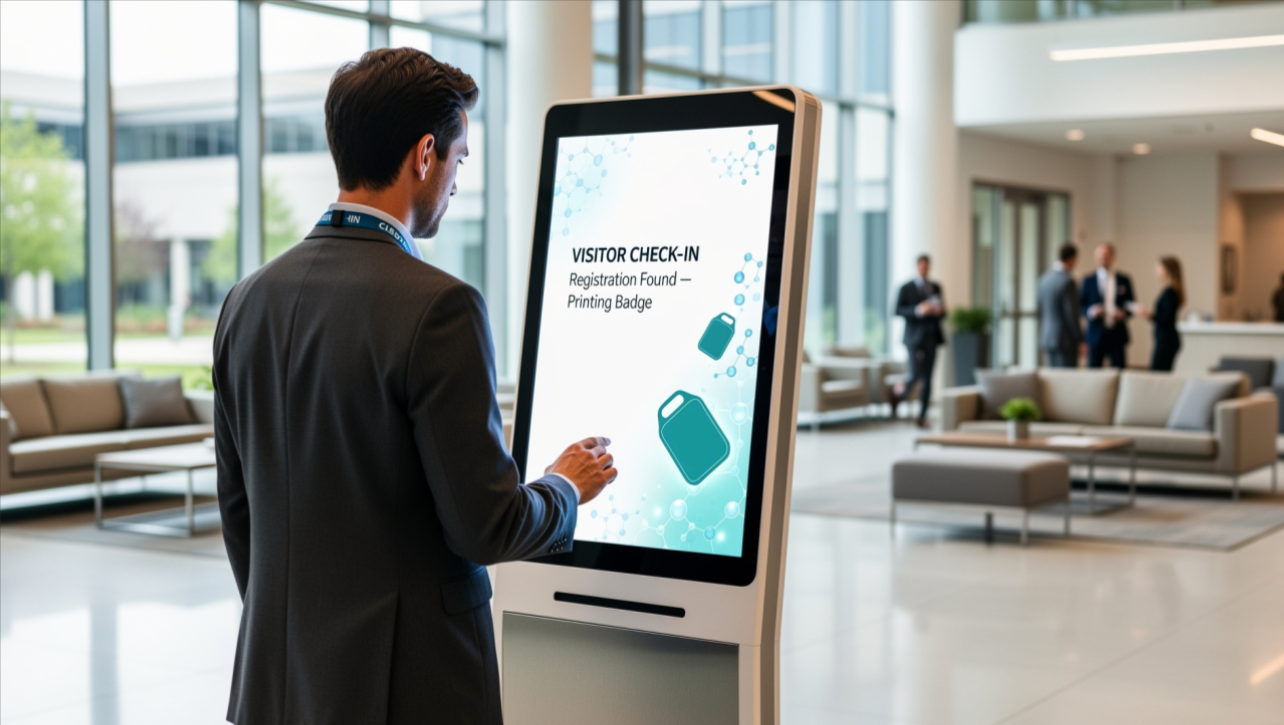
Life sciences buildings operate under regulatory, biosafety, and intellectual property constraints that make visitor management a genuine compliance function rather than a hospitality nicety. Pharmaceutical industry visitors, regulatory inspectors, and vendor representatives accessing research suites need to be credentialed, badged, and logged in a manner that creates an auditable record and enforces access control to restricted areas. Navigo® visitor management capabilities support pre-registration, digital badge issuance, watchlist cross-referencing, and direct integration with building access control systems — enabling streamlined visitor experiences at the lobby level while maintaining the security and compliance standards that life sciences tenants require as a condition of their operations. A Lobby That Reflects the Caliber of the Campus Lobbies now serve as critical brand ambassadors that shape visitor perceptions within seconds of entry — and property owners who approach lobby technology strategically see better returns in the tenant competition. Studio Gascoigne For a campus like 935 Prose at Pike & Rose, explicitly designed to help biotech clients attract and retain world-class talent, the lobby moment is part of the talent value proposition. Scientists and researchers evaluating where they want to work notice when a building's technology environment reflects the ambition of the institution it houses — and they notice when it doesn't.
The Landlord Advantage: Technology-Enabled Lobbies Win LeasesIn a national life sciences market where newly delivered space is competing harder for a more selective tenant pool, the differentiators that matter most are the ones that are immediately visible and experientially meaningful to the people making leasing decisions. The best buildings still lease. Demand has not disappeared — it has simply become more discriminating. Strong tenants want top-tier space, and they know they have options. Propmodo Maryland's pipeline of purpose-built life sciences campuses is positioned to capture that demand precisely because these are not generic office conversions. They are trophy-quality assets designed from the ground up for the specific operational needs of the life sciences industry. The digital lobby infrastructure that greets every tenant, employee, and visitor at the front door is part of what makes those assets perform. A cloud-based interactive directory that stays current, navigates a complex campus, and manages visitor credentialing without friction is one of the most visible and immediately valuable technology investments a life sciences landlord can make — and one of the clearest signals to a prospective tenant that the building is ready to support their work at the highest level.
Bring Your Maryland Life Sciences Campus to Life with Interactive Touchscreen Solutions, Inc. powered by Navigo®Interactive Touchscreen Solutions, Inc. powered by Navigo® partners with life sciences developers, campus landlords, and institutional property managers to deploy cloud-based digital directory, wayfinding, and visitor management systems purpose-built for the demands of research and innovation environments. From the Belward Campus in Shady Grove to the emerging corridors of East Baltimore, the life sciences buildings shaping Maryland's next chapter deserve lobby technology that matches their ambition. Interactive Touchscreen Solutions, Inc. powered by Navigo® is ready to be your building technology partner from the ground up.
Connect with the Interactive Touchscreen Solutions, Inc. powered by Navigo® team to get started.
FAQsWhat makes Maryland's I-270 corridor such a significant life sciences market compared to other regions? Maryland's I-270 corridor has built its standing over decades through a combination of factors that are genuinely difficult to replicate elsewhere. The proximity of the National Institutes of Health in Bethesda — the largest source of biomedical research funding in the world — creates a gravitational pull for life sciences companies that want access to federal research partnerships, regulatory relationships, and the talent pipeline those institutions generate. Johns Hopkins University's consistent track record of spinning out successful commercial companies adds a continuous supply of early-stage ventures looking to establish and grow in the region. The result is an ecosystem that spans the full company lifecycle, from academic spinouts and early-stage biotechs to global pharmaceutical manufacturers — all concentrated along a corridor that has the infrastructure, workforce, and institutional relationships to support them. Why is the lobby specifically such an important investment for a life sciences building? Life sciences buildings serve a more diverse and operationally complex daily population than a typical commercial office building. On any given day, a multi-tenant research campus may receive pharmaceutical industry representatives visiting a biotech partner, regulatory inspectors conducting facility reviews, academic collaborators from other institutions, grant reviewers, vendor representatives delivering lab supplies, and institutional visitors touring the campus. Each of these visitor profiles has a different destination, a different level of familiarity with the building, and in many cases a different level of access authorization. The lobby is the single point through which all of that traffic flows — which means the quality of the directory, wayfinding, and visitor management infrastructure in that space has a direct impact on every person's experience of the building, every single day. In a competitive leasing market where sophisticated tenants evaluate every dimension of a building's quality, the lobby is one of the most immediate and visible expressions of how the property is managed. How does a cloud-based digital directory differ from a traditional lobby directory in a life sciences context? The distinction goes well beyond aesthetics. A traditional printed or changeable-letter lobby directory reflects the building's tenant configuration at a single point in time — which in a life sciences environment becomes inaccurate almost immediately, given how frequently research groups expand, companies add space, and tenant configurations change. A cloud-based digital directory is managed through a central content management system that allows building managers to update tenant information, floor assignments, and navigation content in real time, with changes reflected instantly across every screen in the network — whether that is a single lobby kiosk or a multi-building campus with displays across seven locations. For a development like the Belward Campus, which will build out across multiple phases over several years, that dynamic capability means the directory infrastructure remains accurate and functional throughout the entire construction and lease-up timeline without requiring physical reprinting or on-site installation work. What visitor management capabilities are specifically important for life sciences tenants? Life sciences tenants operate under a set of compliance, biosafety, and intellectual property protection requirements that make visitor management meaningfully different from a standard commercial office environment. Pharmaceutical companies receiving industry partners need a credentialed record of who accessed their space and when. Research facilities with biosafety-level designations need to enforce access control to restricted areas at the building level, not just at the suite level. Companies in active regulatory review need to be able to demonstrate organized, auditable visitor management practices to inspectors. For all of these reasons, a paper sign-in log at a reception desk is not a viable visitor management strategy for a serious life sciences tenant. Systems that support pre-registration, digital badge issuance, watchlist cross-referencing, and direct integration with building access control infrastructure address these requirements in a way that is both operationally efficient and compliance-appropriate. How does digital directory technology support a multi-building campus like Belward specifically? A seven-building campus spanning 60 acres presents wayfinding challenges that are categorically different from a single-building office environment. A visitor arriving at the Belward Campus for the first time — whether they are a pharmaceutical partner, a regulatory representative, or a prospective tenant touring the facility — needs to understand not just which floor their destination is on, but which building to enter, how to get there from the parking structure, and where to go once inside. Campus-wide digital directory systems address this by integrating multi-building maps, inter-building navigation, and mobile handoff into a unified platform. Rather than navigating each building independently, a visitor can receive a complete route from their point of arrival to their specific destination — transferred to their phone via QR code — that guides them across the campus continuously without requiring them to locate another kiosk along the way. How competitive is the life sciences leasing market in Maryland right now, and what does that mean for landlords? The national life sciences real estate market has shifted meaningfully from the peak construction and leasing cycle of 2021 through 2023. A significant volume of new space has delivered nationally, and tenant demand — while still present — has become more selective. The best buildings in the strongest markets continue to lease to high-quality tenants, but those tenants are no longer making decisions under the pressure of scarcity. They have options, and they are using the current environment to make deliberate choices about which buildings and campuses align with their long-term operational needs, their talent strategy, and their brand. For Maryland landlords, this context makes building differentiation more important than it has been in recent years. The physical quality of the lab infrastructure matters enormously — but so does the totality of the building experience, including the lobby, the wayfinding, and the day-to-day operational sophistication of the property. Technology-enabled lobbies with capable digital directory and visitor management systems are one of the clearest signals a landlord can send that their building is managed at the level that premium life sciences tenants expect. At what point in a new development should a life sciences landlord engage with a building technology partner? The most effective approach is to engage at the design and pre-construction phase rather than retrofitting technology after a building opens. Lobby technology infrastructure — power, conduit, network connectivity, mounting positions, kiosk placement, and access control integration — is significantly easier and more cost-effective to incorporate when it is coordinated with the architectural and construction teams from the beginning. For a multi-building campus development like Belward, where buildings will come online in phases, early engagement with a building technology partner also ensures that the directory and wayfinding infrastructure scales coherently across the full campus buildout rather than being deployed piecemeal in ways that create inconsistency across buildings. For buildings already under construction or approaching delivery, deployment is still very achievable — but the planning horizon matters, and the earlier the conversation begins, the better the outcome. How does digital lobby technology contribute to talent attraction for life sciences tenants specifically? Life sciences companies compete intensely for scientific talent, and the physical environment where research happens is a meaningful variable in that competition. Scientists and researchers evaluating career opportunities assess not just the institution's scientific reputation and funding, but the quality of the facilities they will work in every day. A campus like 935 Prose at Pike & Rose is explicitly designed to help biotech clients attract and retain world-class talent — which is why it is embedded in the mixed-use Pike & Rose neighborhood rather than isolated on a suburban campus. The building technology environment contributes to that talent proposition in a specific way: it signals whether a building is operated with the same level of intention and investment as the research happening inside it. A polished, functional, current lobby technology experience — seamless wayfinding, professional visitor management, real-time directory accuracy — communicates to every scientist, researcher, and prospective employee that this is an institution that sweats the details. That signal matters in a talent market where the best people have choices.
Sources: Maryland Department of Commerce Life Sciences Developments; The Belward Campus / Trammell Crow Company / CBRE; Johns Hopkins Hub; Baltimore Fishbowl; NAIOP Maryland Chapter; Montgomery County Economic Development Corporation / Site Selection Magazine; BioHealth Capital Region; Propmodo; halloffamewall.com Digital Wayfinding Guide 2026; studiogascoigne.com Innovative Commercial Lobby Ideas 2026; Pickcel Digital Building Directory Guide 2026.
Contact us today to learn more about Navigo® for your property.
|

7150 Columbia Gateway Drive, Suite L, Columbia, MD 21046
112 West 34th Street, 18th floor, Room 18025 New York, NY 10001
Proud Member

7150 Columbia Gateway Drive, Suite L
Columbia, MD 21046
112 West 34th Street, 18-025
New York, NY 10001
