


Headquarters
7150 Columbia Gateway Drive, Suite L, Columbia, MD 21046
New York Location
112 West 34th Street, 18th floor, Room 18025 New York, NY 10001
Proud Member

Hybrid Work Meets NJ's Office Revival: Using Meeting Room Displays to Maximize Space2 minute read | Updated May 12, 2026
New Jersey's office market is in a genuine recovery. Cushman & Wakefield's senior research manager Bill Simoneau put it directly: market conditions are notably healthier than they were a year ago, the steady reduction in available sublease space and the higher rents commanded by top-tier assets indicate that companies are actively investing in better work environments, and the desire for high-quality spaces is expected to continue driving office leasing decisions throughout the year. Real Estate NJ Tenants across New Jersey continue to seek high-quality, amenity-rich environments that have undergone capital improvements and have financially secure owners and landlords — a trend especially prevalent in transit-oriented markets such as Morristown and Summit, and urban markets such as Newark and Jersey City. Avison Young But the recovery playing out in New Jersey's office market is not a return to 2019. The companies signing leases today are not filling their buildings the same way they used to. According to Newmark, 69% of office tenants in the market plan to maintain or expand their footprint, even as the average lease size is down roughly 12.5% from pre-pandemic levels — and occupiers with hybrid work policies are increasingly moving away from dedicated seats for each employee toward team "neighborhoods" and shared communal areas. PwC The result is a fascinating and important tension: more companies are committed to office space than ever, but they are using that space differently. And nowhere is that tension more visible — or more operationally consequential — than in the conference room.
The Hidden Cost of Hybrid: Ghost Bookings and Wasted SpaceHybrid work has produced one of the most frustrating and pervasive problems in modern office management: the ghost booking. A phantom booking or ghost meeting is a calendar reservation for a meeting room that never results in actual occupancy. Worklytics data shows the booking-to-occupancy ratio in hybrid offices dropped to 0.71 in 2025, meaning nearly 29% of booked rooms go unused. CoworkingCafe The mechanism is familiar to anyone who has worked in a hybrid environment. A team books a conference room for a Thursday afternoon meeting. Wednesday evening, the organizer decides to go remote. No one cancels the room. Thursday arrives, the room sits empty, and two other teams who genuinely needed space for in-person collaboration are left scrambling. According to the Ronspot 2026 Workplace Statistics and Benchmarks Report, 72% of companies now mandate specific attendance days, and 98% of employers record peak utilization on Tuesdays through Thursdays. CoworkingCafe Hybrid schedules have compressed office demand into a narrow mid-week window — which means conference room availability on those peak days is both the most critical and the most contested resource in the building. Meeting room bookings have surged 22% year-over-year, and in nearly 45% to 50% of cases, meeting rooms are used by just one person regardless of room size — a 12-person boardroom occupied by a single person on a Teams call is a policy failure, not a utilization problem. For property managers overseeing Class A buildings competing for flight-to-quality tenants, this is not just an operational inconvenience. It is a leasing variable. Tenants evaluating space ask how well the building supports their hybrid workforce. The answer to that question is increasingly shaped by the quality of the meeting room management infrastructure the building provides.
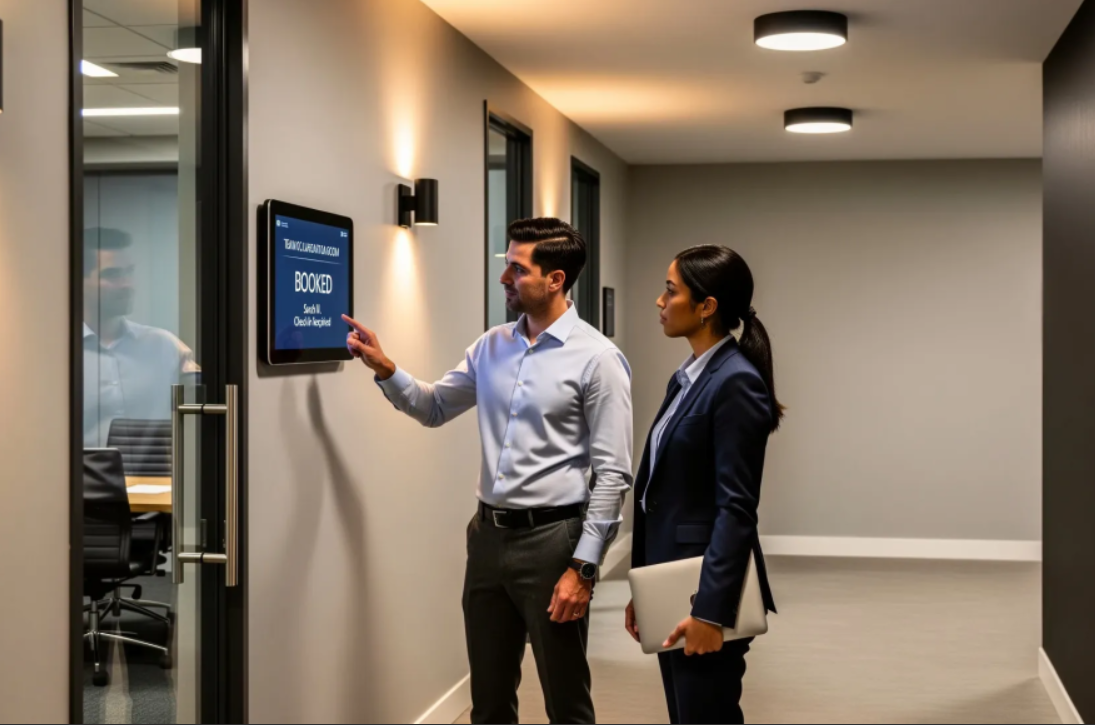
What Meeting Room Display Technology Actually DoesMeeting room display panels — the screen-based systems mounted outside conference rooms that show real-time availability and allow on-the-spot booking — are the most visible and immediately impactful layer of a broader room management ecosystem. But their value extends well beyond the simple question of whether a room is free. Interactive Touchscreen Solutions, Inc. powered by Navigo® delivers meeting room display solutions that integrate directly with the scheduling and calendar systems tenants already use — Microsoft Outlook, Google Calendar, Microsoft Teams, and others — creating a seamless booking experience that works from the display panel, from a desktop, or from a mobile device. At the panel level, Navigo® meeting room displays give employees and visitors immediate, at-a-glance visibility into room status: available, in use, or booked and coming up. On-the-spot booking from the panel takes seconds. Check-in confirmation — where a scheduled occupant must confirm their presence within a defined window or the room is automatically released — directly addresses the ghost booking problem without requiring any policy enforcement from building staff. Clear booking rules, check-in workflows, and integrated scheduling panels can dramatically reduce wasted space and make room utilization far more accurate — and this is where workplace technology becomes a CFO and COO topic, not just an IT topic. UC Today For building owners and property managers, the value proposition is compelling on its own. A building that comes equipped with integrated meeting room display infrastructure removes a meaningful operational burden from incoming tenants and signals a level of technological sophistication that premium tenants have come to expect. In a competitive leasing environment where the difference between a signed lease and a passed opportunity can be as subtle as a building tour impression, these details matter.
Space Utilization Data: From Operational Tool to Leasing AssetOne of the most underutilized capabilities of modern meeting room management systems is the utilization data they generate. Every booking, every check-in, every no-show, and every on-the-spot walk-in interaction is a data point — and over time, that data tells a precise story about how space is actually being used versus how it was planned to be used. A 400-person company with three floors and a Tuesday-Wednesday-Thursday hybrid policy can see 80% peak utilization on Wednesdays but only 30% on Tuesdays. Without scheduling software, the facilities team has no way to know that one floor is packed while another sits empty — and they cannot make the case to finance that one floor could be subleased or repurposed. Gable Global office utilization hit only 54% in 2025 — up from 41% in 2023 — meaning nearly half of paid-for office space still sits unused on any given day. For tenants paying New Jersey Class A rents, that gap between what they're paying for and what they're actually using represents a real and quantifiable cost. Meeting room utilization data gives them the information they need to close it — by right-sizing spaces, reconfiguring underutilized rooms, adjusting booking policies, or making informed decisions about their footprint at renewal. For building owners, that same data becomes a powerful tool for demonstrating space ROI to tenants and supporting the case for lease retention. A property manager who can show a tenant a utilization dashboard and work with them on optimizing their space allocation is providing a service that goes well beyond facilities management. It is strategic partnership — the kind that builds the long-term relationship that produces lease renewals.
The Property Manager's Perspective: Why This Technology Belongs in the BuildingThere is a case to be made that meeting room display and resource scheduling infrastructure should be a building-level offering rather than something each tenant procures independently. The argument is straightforward. When building owners install and maintain meeting room display infrastructure as part of the building's standard technology offering, they accomplish several things simultaneously. They remove a procurement and deployment burden from incoming tenants, which accelerates move-in timelines and reduces friction in the leasing process. They establish a consistent technology standard across the building that supports multi-tenant environments more cleanly than a patchwork of different tenant-installed systems. They create a differentiated amenity that is increasingly visible during building tours. And they gain access to building-wide utilization data that informs capital planning, space allocation, and the ongoing case for building quality. New Jersey market participants are increasingly focused on fundamentals — and features like app-based access control, IoT-enabled systems, and automated building technology are positioning properties for long-term competitiveness. Real Estate NJ Meeting room display systems sit directly in that category: practical, visible, and immediately valuable to the tenants whose daily experience they improve.
Matching Technology to How Tenants Actually WorkThe broader lesson of the hybrid era is that office space needs to earn its place in the workweek. Employees who have experienced the flexibility of remote work are selective about when and why they come in — and the quality of the in-person collaboration experience is a primary variable in that decision. A building that makes it easy to find a room, book it in real time, and use it without friction is a building that supports the collaborative intent that brings people in on a Tuesday or Wednesday in the first place. The future of work is hybrid. The question is whether it feels fair, effortless, and worth showing up for. The best modern meeting room technology improves the experience for everyone — not just the people in the room — and the best office intelligence tools help leaders invest confidently, with data that reflects real behavior. UC Today New Jersey's recovering office market is rewarding buildings that have made the commitment to quality across every dimension of the tenant experience. Meeting room displays are one of the most visible, daily-use expressions of that commitment — and one of the clearest signals to a prospective tenant that this building understands how work actually happens in 2026.
Optimize Your Building's Meeting Room Infrastructure with Interactive Touchscreen Solutions, Inc. powered by Navigo®Interactive Touchscreen Solutions, Inc. powered by Navigo® helps property managers, building owners, and corporate tenants across New Jersey deploy meeting room display systems and resource scheduling technology that reduce ghost bookings, surface utilization data, and elevate the day-to-day office experience for every person in the building. In a market where flight-to-quality tenants are making sophisticated decisions about where to commit their real estate dollars, the operational and experiential quality of your building's technology infrastructure is part of the value proposition. Interactive Touchscreen Solutions, Inc. powered by Navigo® is ready to help you build it.
Connect with the Interactive Touchscreen Solutions, Inc. powered by Navigo® team to get started →
FAQsWhy is hybrid work creating space management problems if more companies are committing to office leases? The commitment to office space and the challenge of managing that space efficiently are two separate issues — and hybrid work has driven a wedge between them. Companies are signing leases because they believe in the value of in-person collaboration, but their employees are arriving on inconsistent schedules concentrated into a narrow mid-week window. The result is a building that feels overstaffed on Wednesdays and underutilized on Mondays and Fridays — sometimes on the same floor simultaneously. Conference rooms get caught in the middle: over-reserved by teams hedging their schedules and under-occupied when those same teams shift to remote. The challenge isn't that companies don't need space. It's that the patterns of how they use it have become harder to predict and manage without the right technology infrastructure in place. What is a ghost booking and why is it such a persistent problem in hybrid offices? A ghost booking — also called a phantom meeting — is a conference room reservation that never results in actual occupancy. Someone books the room, plans change, and no one cancels the reservation. The room sits empty while other teams who need it can't access it because the calendar shows it as taken. The problem persists in hybrid environments for a straightforward behavioral reason: booking a room costs nothing and canceling requires effort, so employees treat reservations as insurance policies rather than firm commitments. When hybrid schedules compress office attendance into two or three peak days per week, ghost bookings don't just waste space — they actively block collaboration by creating artificial scarcity on the days when real demand is highest. Worklytics data from 2025 found that nearly 29% of booked rooms go unused, which means roughly one in three conference room reservations represents wasted space that other teams couldn't access. How does meeting room display technology reduce ghost bookings specifically? The most effective mechanism is the check-in confirmation workflow. When a meeting room display system requires the booking party to confirm their presence at the panel within a defined window after the meeting's scheduled start — typically five to ten minutes — any room that doesn't receive a check-in is automatically released back into the available inventory. This single feature can substantially reduce the ghost booking rate without requiring any behavioral change from the broader workforce, because the system handles the enforcement automatically. Beyond check-in, display panels also make the real-time availability of every room visible at a glance, which reduces the tendency to book speculatively. When employees can see that rooms are genuinely available and easily bookable from the panel itself, they are less likely to lock in a reservation hours in advance as a precaution. What is the difference between meeting room display technology and a room scheduling software platform? Meeting room display panels and scheduling software platforms are complementary layers of the same system rather than competing alternatives. The display panel is the physical hardware mounted outside the conference room — the screen that shows current status in real time, allows on-the-spot booking, and processes check-in confirmations. The scheduling software platform is the back-end system that manages bookings, enforces policies, integrates with calendar applications like Microsoft Outlook and Google Calendar, and generates the utilization analytics that inform space decisions. Most enterprise-grade implementations include both: the software platform provides the intelligence and the data, while the display panels provide the physical interface that employees interact with every day. For building owners evaluating technology offerings, understanding this distinction matters because the panel is what tenants see and experience, while the platform is what generates the long-term operational and strategic value. How should building owners think about providing meeting room technology as a building amenity versus leaving it to individual tenants? There is a compelling case for building owners to include meeting room display infrastructure as part of the building's standard technology offering rather than treating it as a tenant responsibility. When the building provides the infrastructure, incoming tenants avoid the procurement, deployment, and integration process entirely — which reduces friction in the leasing and move-in experience and signals a level of operational sophistication that premium tenants notice during tours. A consistent technology standard across the building also supports multi-tenant environments more cleanly than a mix of different systems installed by different tenants over time. And building-level infrastructure gives property managers access to utilization data at the portfolio level — information that informs capital planning, space reconfiguration decisions, and the ongoing case for building quality that supports lease renewals and attracts new tenants. What utilization metrics should property managers and tenants actually be tracking? The most meaningful metrics go beyond simple booking rates to capture the gap between intended and actual space use. Booking adoption rate — what percentage of employees are making at least one booking per week — establishes whether the system is being used at all. No-show rate — bookings that don't result in check-ins — directly quantifies the ghost booking problem. Peak utilization by floor and day of week reveals the concentration patterns that hybrid schedules create, and informs decisions about how to balance capacity across the building. Room-to-occupancy ratio — how often rooms are used at or near their stated capacity versus occupied by a single person regardless of room size — helps identify mismatches between available room types and actual meeting patterns. Together these metrics give both property managers and tenants a data-driven foundation for space decisions that goes well beyond gut feel or anecdotal observation. How does meeting room technology contribute to tenant retention at lease renewal? Tenant retention at renewal is ultimately about the quality of the relationship between the landlord and the tenant, and the degree to which the tenant feels the building supports their success. Meeting room technology contributes to that relationship in a specific and tangible way: it gives property managers the utilization data and operational tools to have genuinely useful conversations with tenants about how their space is performing and how it could be optimized. A property manager who brings a utilization dashboard to a lease renewal conversation — showing peak day patterns, room size utilization trends, and booking efficiency metrics — is demonstrating a level of engagement with the tenant's operations that most landlords never achieve. That kind of strategic partnership is harder to walk away from than a lease with a marginally lower rent at a competing building. In a market where Class A tenants have real choices, the relationship and the operational experience of the building are meaningful retention variables. Is meeting room display technology difficult to integrate with the calendar and communication tools tenants already use? Modern meeting room display and scheduling platforms are designed specifically for integration with the enterprise tools that most professional services and technology tenants already rely on daily. Microsoft Outlook, Google Calendar, Microsoft Teams, and Slack are standard integration targets for leading platforms, which means bookings made from the display panel sync immediately to the tenant's existing calendar infrastructure and vice versa. This bidirectional sync is what prevents double bookings and ensures that a reservation made from a desktop calendar shows up as occupied on the physical display panel in real time. For building owners evaluating technology vendors, the depth and reliability of calendar integrations is one of the most important practical criteria — because a meeting room system that doesn't communicate cleanly with the tools employees use every day will see low adoption, which defeats the entire purpose of the investment.
Sources: Real Estate NJ; Cushman & Wakefield Q1 2026 New Jersey MarketBeat; Avison Young New Jersey Office Market Report; Newmark via PwC Emerging Trends in Real Estate 2026; Ronspot 2026 Workplace Statistics and Benchmarks Report; Worklytics Hybrid Meeting Room Analysis; UCToday Hybrid Meeting Room Technology 2026; Gable.to Workplace Scheduling Software Guide 2026; Wolf Commercial Real Estate Q1 2026 Report; Real Estate NJ 2026 Market Forecast.
Contact us today to learn more about Navigo® for your property. |

7150 Columbia Gateway Drive, Suite L, Columbia, MD 21046
112 West 34th Street, 18th floor, Room 18025 New York, NY 10001
Proud Member

7150 Columbia Gateway Drive, Suite L
Columbia, MD 21046
112 West 34th Street, 18-025
New York, NY 10001
