

Headquarters
7150 Columbia Gateway Drive, Suite L, Columbia, MD 21046
New York Location
112 West 34th Street, 18th floor, Room 18025 New York, NY 10001
Proud Member


DNA Alley at Scale: How Maryland's Life Sciences Campuses Manage Thousands of Daily Visitors3 minute read | Updated May 7, 2026
Maryland's life sciences ecosystem is not simply a cluster of companies doing similar work in the same geography. It is a dense, interconnected web of federal agencies, academic institutions, private pharmaceutical companies, contract research organizations, government-adjacent research facilities, and early-stage biotechs — all generating daily visitor traffic that operates under compliance frameworks that have no equivalent in commercial office real estate. For the third consecutive year, the BioHealth Capital Region — encompassing Maryland, Virginia, and Washington, D.C. — earned a Top 3 position in GEN's U.S. Biopharma Cluster Rankings, leading the nation in biotechnology-related patents and ranking third in both NIH funding and lab space. BioHealth Innovation The full scope of the ecosystem is staggering: the BioHealth Capital Region boasts $4.245 billion in NIH funding, $12.16 billion in VC funding, 52,899 patents, 31.69 million square feet of lab space, and 128,886 jobs. Maryland Government At the center of this ecosystem is a federal research presence unlike anything found in any other life sciences market in the country. The National Institutes of Health maintains its headquarters for federal biomedical and health-related research in Bethesda, with over 17,000 employees across its Maryland facilities in Bethesda, Rockville, Frederick, and Baltimore — while the Food and Drug Administration operates its headquarters for federal food and drug regulation in White Oak, Maryland. Maryland Department of Commerce The BioHealth Capital Region is home to more than 1,800 life sciences companies and over 70 federal labs and academic and research institutions. Milrose These are not simply office buildings. They are regulated research environments, government-adjacent facilities, pharmaceutical manufacturing campuses, and biosafety-designated laboratory complexes — environments where the question of who is in the building at any given moment is a compliance matter, not just an operational convenience.
Visitor Management in a Regulated Research Environment Is a Different Problem
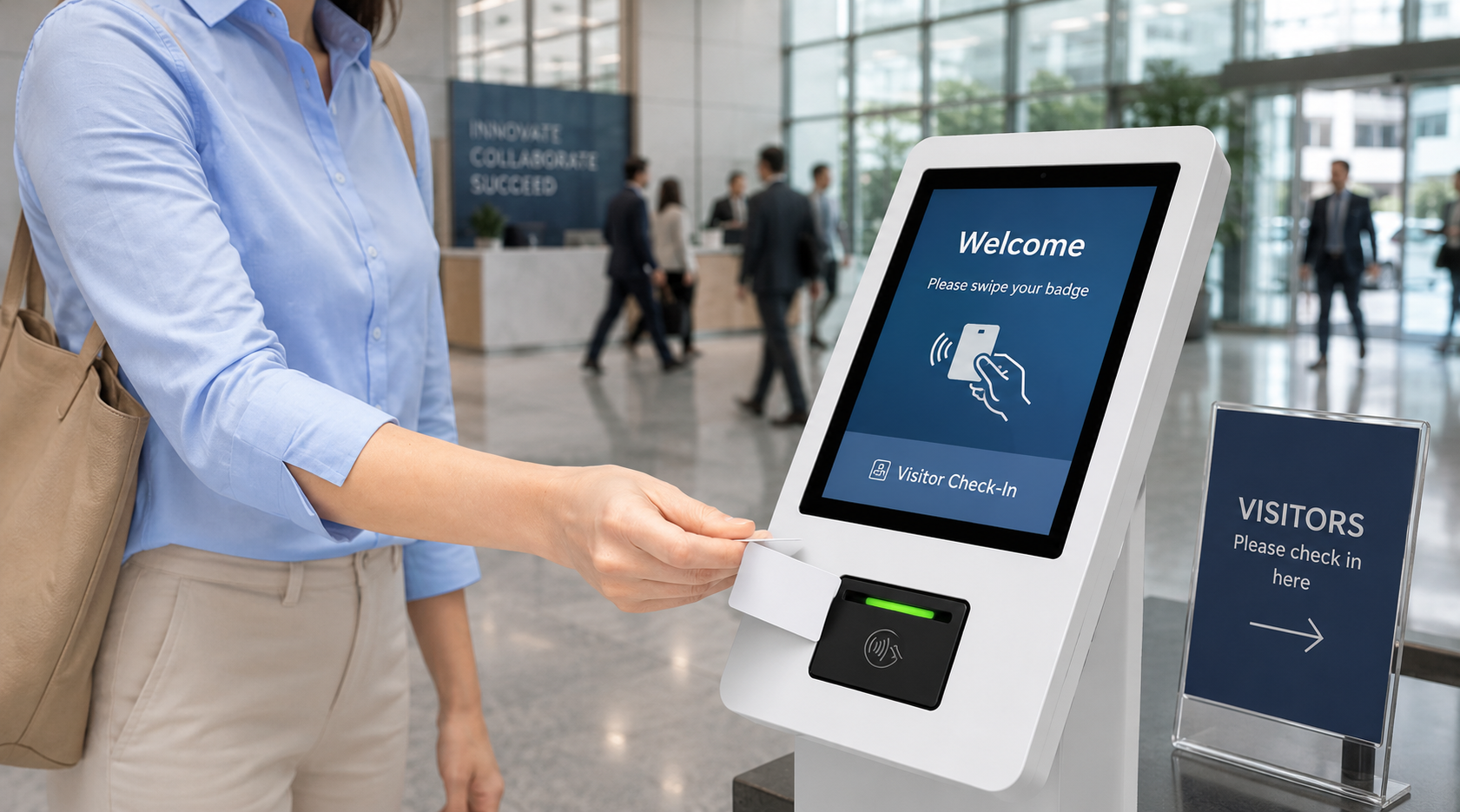
It is worth being explicit about what makes visitor management in Maryland's life sciences corridor categorically different from managing visitor flow in a conventional commercial building. In a Class A office building, a visitor management challenge is primarily about efficiency and experience: getting people signed in, badged, and to their destination quickly without creating a bottleneck at the reception desk. The stakes are operational. A poorly managed lobby creates friction and makes a bad first impression. In a pharmaceutical manufacturing facility, a government-adjacent research campus, or a biosafety-level laboratory environment, the stakes are fundamentally different. Visitor management is a regulatory obligation with enforceable legal consequences. The FDA's current Good Manufacturing Practice regulations outline strict visitor controls governing who enters pharmaceutical facilities. GMP requirements extend beyond employees to include contractors, vendors, and visitors — each person who steps into a restricted area must be documented, verified, and tracked, with records maintained for FDA inspectors. Traditional visitor logbooks and manual tracking systems create compliance gaps that FDA inspectors consistently flag during audits. Sign In Solutions FDA inspectors enforce strict facility access control requirements under 21 CFR Part 211.28, which mandates that only authorized personnel shall be allowed in areas designated as limited-access areas. Their evaluations closely scrutinize visitor identification systems, verification processes, training documentation, movement records through restricted areas, evidence of consistent policy enforcement, and comprehensive audit trails. Even minor documentation gaps — a missing signature or incomplete log entry — can trigger Form 483 observations or warning letters. Sign In Solutions Visitor management software specifically helps facilities stay compliant with cGMP by tracking those who enter and exit a facility or section of a building, recording data related to personnel qualifications, and maintaining auditable records of who has been in a manufacturing facility — a powerful tool for compliance monitoring and, in the rare cases when things go wrong, for answering questions for facilities managers and government regulators. Sine by Honeywell The NIH's own campus access protocols illustrate the rigor these environments demand. All patients and visitors ages 18 and older must go through security and be issued a visitor badge to enter the NIH campus, with vehicles undergoing security screening and visitors required to state the purpose of their visit in order to receive a pass. Nih NIH has developed a specialized visitor access program specifically designed to meet legal safety standards while fulfilling the NIH mission, taking special consideration to allow easier entry for large groups visiting for symposiums, special delegations, patients, and caregivers. NIH Record This is the compliance and security landscape that Maryland's life sciences campuses operate within every day — and it is the landscape that building technology solutions need to address directly.
The Visitor Profiles Maryland Life Sciences Campuses Actually ManageUnderstanding why visitor management at scale is so complex in this ecosystem requires understanding who is actually walking through the lobby of a Maryland life sciences facility on a given day. Regulatory Inspectors. The FDA's headquarters in White Oak and the NIH's presence across Montgomery County mean that Maryland life sciences companies operate in closer proximity to federal regulators than their counterparts in Boston or San Francisco. FDA inspectors arriving for facility inspections require credentialed access, a clear audit trail of where they went and when, and a visitor management process that reflects the compliance culture of the organization being inspected. Pharmaceutical Industry Partners. Biomanufacturing companies and contract research organizations along the I-270 corridor host a continuous flow of pharmaceutical partner representatives — companies evaluating manufacturing capacity, reviewing batch records, or conducting vendor qualification audits. Each of these visits requires controlled access to specific areas, with IP protection considerations that make unrestricted building movement a liability. Academic Collaborators and Grant Reviewers. The proximity of Johns Hopkins, the University of Maryland, and the NIH creates a dense web of academic-industry collaboration that generates regular visitor traffic between institutions — researchers visiting partner labs, grant review panels visiting funded facilities, and visiting scientists spending extended time in host institutions. Supply Chain Vendors and Delivery Personnel. Biomanufacturing facilities receive specialized laboratory equipment, reagents, controlled substances, and cold-chain biological materials from vendors who need controlled access to specific receiving and storage areas — not unrestricted building access. International Visitors. Maryland's position as a federal research hub attracts a significant volume of international scientific visitors. NIH policy requires specific credentialing protocols for all non-U.S. person visitors to NIH facilities, with visitors required to wear their badges above the waist in plain view at all times within NIH campuses — a compliance requirement that extends to multi-tenant facilities where NIH occupies space. Nih Each of these visitor profiles requires a different credentialing workflow, a different level of access authorization, and a different documentation trail. Managing all of them through a paper sign-in log is not a compliance strategy. It is a liability.
What Digital Kiosks and Lobby Displays Solve at ScaleInteractive visitor management kiosks powered by Navigo® address the specific operational and compliance demands of Maryland's life sciences visitor environment through a set of capabilities that paper-based and manual systems fundamentally cannot replicate. Pre-Registration and Appointment Verification. For research campuses managing hundreds of visitors per day across dozens of research groups, requiring every visitor to be manually processed at reception creates a bottleneck that backs up lobbies, delays scheduled meetings, and creates exactly the kind of compliance gap that FDA inspectors look for. Pre-registration workflows allow hosting researchers or corporate hosts to submit visitor information in advance — identity, purpose of visit, access areas required — enabling digital badge generation and appointment confirmation at the kiosk upon arrival without requiring staff intervention for every standard visitor. Digital Badging with Access Level Differentiation. Not every visitor in a life sciences building requires the same access. A pharmaceutical partner representative visiting a GMP manufacturing suite needs different building access than a vendor delivering to the receiving dock, a grant reviewer touring a research lab, or a job candidate interviewing in the administrative wing. Digital badging systems integrated with building access control infrastructure enforce these distinctions automatically — issuing badges pre-programmed to allow access only to the areas a visitor is authorized to enter, and logging every movement for the audit trail that regulatory compliance demands. Watchlist Cross-Referencing. For government-adjacent research facilities and pharmaceutical companies operating under federal contracts, the ability to cross-reference visitor identity against institutional watchlists before issuing building access is a security requirement, not a feature. Navigo® visitor management capabilities support automated watchlist checks integrated into the check-in workflow — completing the verification before a badge is issued, without requiring manual security staff intervention for every visitor. Compliant Electronic Audit Trails. GMP compliance requires that companies document procedures and provide proof for audits that regulations are consistently followed — and simplifying the visitor management process creates an opportunity to reduce compliance risk while increasing control and auditability of the data. Sign In Enterprise Digital visitor management systems create comprehensive, tamper-resistant electronic records of every visitor interaction — identity verified, access areas logged, time-stamped entries and exits, host notifications sent and acknowledged — that are immediately available for FDA inspection review without requiring manual compilation of paper records. Multi-Building Campus Navigation. A visitor arriving at a large Maryland life sciences campus — such as the NIH's 300-acre Bethesda campus, or a multi-building research park along the I-270 corridor — faces a genuine navigation challenge after they clear the entrance security process. Navigo® interactive directory and wayfinding systems guide credentialed visitors from the lobby to their specific destination across a complex multi-building environment, reducing the staff time spent directing people and ensuring that visitors with restricted access stay on authorized routes.
The Compliance Case for Modern Visitor InfrastructureThe financial and operational consequences of inadequate visitor management in a regulated life sciences environment are not hypothetical. Every year, pharmaceutical companies face millions in potential FDA fines for compliance violations — most of which are entirely preventable, stemming from inadequate visitor control and documentation in restricted areas. FDA violations from inadequate visitor management can trigger warning letters, consent decrees, or production shutdowns.Sign In Solutions Montgomery County companies attracted $2.9 billion in investment during 2024 across mergers, acquisitions, venture capital, and private funding, with life sciences accounting for more than half a billion dollars. BioHealth Innovation Companies operating at this scale of capital deployment cannot afford the compliance exposure that paper-based visitor management creates — and investors providing that capital increasingly evaluate operational infrastructure as part of their due diligence.
Build a Compliant, Scalable Visitor Management Infrastructure with Interactive Touchscreen Solutions, Inc. powered by Navigo®Interactive Touchscreen Solutions, Inc. powered by Navigo® deploys visitor management kiosks, digital badging systems, and lobby directory and wayfinding technology purpose-built for the compliance demands of regulated life sciences and government-adjacent research environments. From pharmaceutical manufacturing campuses along the I-270 Bio Corridor to multi-tenant research parks in Shady Grove, Gaithersburg, and East Baltimore, Maryland's life sciences facilities deserve visitor management infrastructure that protects their compliance posture, supports their FDA readiness, and keeps hundreds of daily visitors moving efficiently through complex, security-conscious environments. Interactive Touchscreen Solutions, Inc. powered by Navigo® is ready to build that infrastructure with you. Connect with the Interactive Touchscreen Solutions, Inc. powered by Navigo® team to get started →
FAQsWhy is visitor management in a Maryland life sciences facility fundamentally different from visitor management in a standard commercial office building? The difference comes down to what is at stake when the process fails. In a conventional office building, a visitor management failure means someone waited too long at reception or got lost finding a conference room. In a pharmaceutical manufacturing facility, a GMP-regulated research environment, or a government-adjacent campus, a visitor management failure can trigger an FDA Form 483 observation, a warning letter, or in serious cases a consent decree or production shutdown. The FDA's current Good Manufacturing Practice regulations require that every person entering a restricted area — not just employees, but contractors, vendors, and visitors — be documented, verified, tracked, and included in records maintained for regulatory inspection. A paper sign-in log with missing signatures or incomplete entries is not a minor inconvenience in this context. It is a compliance gap with legal and financial consequences. Maryland's concentration of pharmaceutical manufacturers, federal research facilities, and government-adjacent campuses means this higher standard of visitor management applies across a significant portion of the state's commercial life sciences real estate. What specific FDA regulations govern visitor access in pharmaceutical and research facilities? The primary regulatory framework is the FDA's current Good Manufacturing Practice regulations under 21 CFR Part 211, which establishes requirements for pharmaceutical manufacturing facilities. Section 211.28 specifically mandates that only authorized personnel shall be allowed in areas designated as limited-access areas — a requirement that FDA inspectors enforce rigorously during facility audits. For electronic visitor management systems, 21 CFR Part 11 governs electronic recordkeeping and requires that digital audit trails meet data integrity standards, including tamper resistance and the ability to reconstruct a complete record of all facility access events. Separately, facilities receiving NIH funding or operating under federal research agreements are subject to additional access control requirements established by the Department of Health and Human Services and enforced through NIH's own campus security policies. For Maryland life sciences companies operating internationally, the European Medicines Agency and UK's MHRA enforce their own parallel access control standards — making a unified digital visitor management platform that can adapt to multiple regulatory frameworks particularly valuable for companies with global operations. How does digital visitor management technology support FDA inspection readiness specifically? FDA inspectors conducting facility audits examine visitor management as part of their evaluation of a company's overall compliance posture. What they look for is evidence that the facility consistently enforces its access control policies — not just that policies exist on paper. A digital visitor management system supports inspection readiness in several concrete ways. It creates a comprehensive, timestamped electronic record of every visitor interaction — identity verified, access areas visited, host notifications sent and acknowledged, entry and exit times logged — that is immediately retrievable without manual record compilation. It demonstrates consistent policy enforcement by automating the verification steps that manual processes are most likely to skip under time pressure. And it provides the kind of audit trail that satisfies 21 CFR Part 11 data integrity requirements in a way that paper logs simply cannot. When an FDA inspector asks to review visitor records for the past six months, a digital system produces that information in minutes. A paper-based system produces a stack of logbooks and a compliance risk. What makes the NIH's visitor management requirements particularly complex compared to a private pharmaceutical company? The NIH campus in Bethesda is a federal government facility operating under the Homeland Security Presidential Directive 12, which established a government-wide standard for secure and reliable identification for accessing federal facilities and systems. This means NIH's badging and access control requirements are not simply institutional policy — they are federal mandates enforced through a dedicated Division of Personnel Security and a Physical Access Control System that tracks every credentialed individual's authorized access to specific buildings, floors, and restricted spaces across the campus. For multi-tenant buildings where NIH occupies space alongside private sector tenants, NIH's access control requirements apply specifically to NIH-occupied areas — creating a building where different sections operate under different compliance frameworks simultaneously. For private life sciences companies co-locating with NIH-affiliated research, this creates a visitor management environment where the system needs to be sophisticated enough to enforce differentiated access levels across the same building while maintaining complete documentation for each framework independently. How does pre-registration capability change the visitor experience at a high-volume life sciences campus? The visitor experience at a large research campus — where hundreds of visitors may arrive on a given day across dozens of research groups and administrative departments — is disproportionately shaped by what happens in the first five minutes after arrival. Without pre-registration, every visitor requires manual processing: identity verification, host notification, access authorization, badge printing, and routing guidance, all happening in sequence at a reception desk while others wait. At peak arrival windows — morning start times, post-lunch periods, major conference or symposium days — this creates exactly the kind of lobby bottleneck that reflects poorly on the facility and frustrates the visitors it is supposed to serve. Pre-registration workflows change this dynamic entirely. When a hosting researcher or corporate host submits visitor information in advance, the system can verify identity, pre-authorize access, and stage badge generation so that the visitor's arrival at the kiosk is a confirmation step rather than an intake process. For large-group visits — NIH symposia, investor tours, regulatory delegation visits — pre-registration is the operational difference between a smooth, professional experience and a lobby that feels overwhelmed. What is watchlist cross-referencing and which types of Maryland life sciences facilities need it most? Watchlist cross-referencing is the automated verification of a visitor's identity against one or more institutional security databases before building access is granted. In a life sciences context, this capability is most critical for facilities with federal contracts, government research partnerships, or biosafety designations — environments where unauthorized access by certain individuals represents a national security or research integrity risk, not just a property security risk. For companies operating under federal research funding agreements, export control regulations impose specific requirements about which foreign nationals can access certain research areas and technologies. For pharmaceutical manufacturers working on controlled substances or biodefense-related products, the ability to automatically flag and escalate visitors whose identity triggers a watchlist match — before a badge is issued and building access is granted — is a meaningful security control that manual check-in processes cannot reliably replicate. The NIH's specific policy for non-U.S. person visitors, which requires host notification and documentation before access is granted, is effectively a manually administered version of the same principle — and digital systems that automate this check reduce both the administrative burden on hosts and the compliance risk of inconsistent enforcement. How should a life sciences company evaluate whether its current visitor management process creates compliance risk? The most direct evaluation is to ask whether your current visitor management process would produce a clean answer to the questions an FDA inspector is most likely to ask. Can you immediately retrieve a complete, timestamped record of every person who accessed a restricted area of your facility in the past twelve months? Can you demonstrate that every visitor was verified against your authorized access list before entry? Can you show that your NDA or CDA acknowledgment process was consistently administered for every industry visitor who had access to proprietary research areas? Can you prove that your access control policies were enforced uniformly — not just when a senior compliance officer was present, but for every routine vendor delivery and every scheduled partner meeting? If the honest answer to any of these questions involves the phrase "we would need to pull paper logs and cross-reference multiple systems," then the current process creates compliance exposure. Digital visitor management systems are specifically designed to make these questions answerable immediately, consistently, and without manual compilation. Can digital visitor management systems integrate with the existing access control infrastructure already installed in most life sciences buildings? Modern visitor management platforms are designed with integration as a core capability rather than an afterthought, and Navigo® specifically supports direct connectivity with leading access control systems including Genetec, AMAG, and C-CURE — the platforms most commonly deployed in institutional and life sciences building environments. This integration means that a badge issued through the visitor management system is not simply a printed identification card. It is a credential registered in the building's access control system with the specific permissions that visitor has been authorized to have — allowing them through the doors they are supposed to enter and logging their passage through the system's audit trail automatically. For a pharmaceutical manufacturing facility with multiple restricted zones operating under different access control rules, this integration enforces access differentiation automatically without requiring security staff to manually accompany every visitor to their destination. For a multi-building research campus, it means a single credentialing event at the lobby kiosk can be configured to govern access across the full campus according to whatever permissions the visitor has been pre-authorized to hold.
Sources: BioHealth Innovation, Inc. Top 10 BioHealth Capital Region Stories of 2025; Maryland Department of Commerce Life Sciences Fact Sheet; BioHealth Capital Region; milrose.com Introduction to Life Sciences in the DMV Region; NIH Security / Visitor Campus Access; NIH Policy Manual; Sign In Solutions Pharmaceutical Visitor Management and FDA Compliance; Sign In Enterprise VMS and GMP Compliance; FDA Current Good Manufacturing Practice (CGMP) Regulations; NAIOP Maryland Chapter.
Contact us today to learn more about Navigo® for your property.  |
7150 Columbia Gateway Drive, Suite L, Columbia, MD 21046
112 West 34th Street, 18th floor, Room 18025 New York, NY 10001
Proud Member

7150 Columbia Gateway Drive, Suite L
Columbia, MD 21046
112 West 34th Street, 18-025
New York, NY 10001
