

Headquarters
7150 Columbia Gateway Drive, Suite L, Columbia, MD 21046
New York Location
112 West 34th Street, 18th floor, Room 18025 New York, NY 10001
Proud Member


Bridging the Hybrid Gap: Designing Collaborative Workspaces for Seattle's Tech Sector3 minute read | Updated June 19, 2026
Healthcare in Western Washington is operating at a moment of significant transformation. The region's major health systems — Providence Health & Services, UW Medicine, MultiCare Health System, Virginia Mason Franciscan Health, and the Oregon Health & Science University network extending its influence across the Portland metropolitan area — are simultaneously navigating rising patient volumes, workforce pressures, an accelerating shift toward value-based care models, and the operational demands of some of the most ambitious facility expansion programs in the Pacific Northwest's history. UW Medicine's ongoing investments in its flagship Medical Center and regional network. Providence's continued expansion across Western Washington's suburban and rural catchment areas. OHSU's capital programs in Portland and its growing regional presence. MultiCare's network of hospitals and ambulatory care facilities serving the Puget Sound corridor from Tacoma to the Cascade foothills. These are large, complex, and deeply consequential institutions — and the quality of the patient experience they deliver, the efficiency of their clinical operations, and the safety of their care environments are shaped in meaningful ways by the technology infrastructure embedded throughout their facilities. Interactive touch screen technology has moved from a peripheral amenity to a core operational tool across this landscape. From the moment a patient enters a facility through the front door to the moment they leave with a clear understanding of their care plan, digital touch screen systems are streamlining workflows, reducing wait times, improving communication between patients and care teams, and creating safer, more responsive care environments. For the health system executives, facility planners, clinical informatics leaders, and CRE developers building and managing Western Washington's healthcare infrastructure, understanding this technology and its full range of applications is increasingly essential.
The Patient Experience Imperative in Pacific Northwest HealthcareBefore examining specific technology applications, it's worth understanding the strategic context in which Western Washington's health systems are making technology investment decisions — because patient experience is no longer simply a service quality metric. It is a financial and competitive imperative. The Centers for Medicare & Medicaid Services (CMS) Hospital Consumer Assessment of Healthcare Providers and Systems (HCAHPS) program ties a meaningful portion of hospital reimbursement to patient experience scores. Health systems that score well on HCAHPS metrics — which include communication clarity, responsiveness of staff, and the overall rating of the care experience — receive higher value-based care payments. Those that score poorly face financial penalties. In a reimbursement environment where margins are thin and every basis point of revenue matters, patient experience is directly connected to financial performance. Beyond reimbursement, Western Washington's healthcare market is genuinely competitive. Patients with non-emergency care needs have meaningful choice among providers — and the quality of the experience, not just the clinical outcome, is increasingly a factor in where they choose to seek care and whether they return. Press Ganey's 2023 Consumer Experience Trends in Healthcare Report found that patient-reported experience scores correlate directly with patient loyalty and referral behavior, and that technology-enabled convenience — including digital check-in, clear wayfinding, and digital access to health information — is among the top drivers of positive experience ratings across all patient demographics.¹ For health system executives making technology investment decisions, the case for interactive touch screen infrastructure is therefore not purely operational. It is strategic — connected to reimbursement performance, competitive positioning, and the long-term loyalty of a patient population that has more choices than ever before.
Streamlining Patient Check-In: Reclaiming Time at the Front DoorThe patient check-in process is one of the most consequential touchpoints in the healthcare experience — and one of the most consistently identified sources of frustration. Long wait times at registration desks, paper-based intake forms that require patients to transcribe information they've already provided, and front desk bottlenecks that create congestion in lobby areas all contribute to a first impression that can set the tone for everything that follows. Interactive self-service check-in kiosks address these friction points directly and measurably. A patient arriving for a scheduled appointment at a UW Medicine clinic or a Providence primary care facility can approach a touch-enabled check-in terminal, verify their identity through a simple biometric or insurance card scan, confirm their demographic and insurance information, complete digital intake forms, and receive a notification that their care team has been alerted — all within two to three minutes, without waiting in a registration line. The operational impact of this technology is well-documented. A 2022 study published in the Journal of the American Medical Informatics Association (JAMIA) found that health systems deploying self-service check-in kiosks reduced average patient registration time by 47% and decreased front desk staffing requirements during peak hours by approximately 30% — freeing clinical support staff to focus on higher-value patient interactions rather than administrative processing.² For a large multispecialty clinic with 400 patient visits per day, those efficiency gains translate to meaningfully shorter wait times, reduced lobby congestion, and a better first impression for every patient who walks through the door. The accuracy benefits are equally significant. Digital intake forms that pre-populate with existing patient record data and prompt patients to confirm or update specific fields consistently produce higher-quality, more complete data than paper-based forms transcribed by intake staff — reducing downstream errors in clinical documentation, billing, and care coordination. For health systems operating under the documentation requirements of value-based care contracts, that data quality improvement has direct clinical and financial implications. For Western Washington's health systems specifically — many of which are managing high patient volumes across geographically distributed networks of hospitals, clinics, and ambulatory care centers — the ability to standardize the check-in experience across facilities through a consistent, well-designed kiosk platform is particularly valuable. A patient who checks in seamlessly at a Providence clinic in Renton should have the same experience at a Providence facility in Olympia. Technology makes that consistency achievable in a way that staffing-dependent processes cannot.
Interactive Patient Education: Transforming the Consultation RoomOne of the most clinically significant applications of interactive touch screen technology in healthcare is the interactive patient education system — and it represents an area where technology is genuinely enhancing the quality of care, not just the efficiency of its delivery. The challenge of patient education in a clinical consultation is well understood. Physicians and care teams have limited time with each patient. The information they need to communicate — about diagnoses, treatment options, medication regimens, post-visit care instructions, and the anatomical or physiological processes underlying a patient's condition — is often complex, technical, and unfamiliar. Patients are frequently anxious, processing new and sometimes alarming information, and may retain only a fraction of what they hear in a verbal explanation. The gap between what care teams communicate and what patients understand and act on is one of the most significant contributors to poor health outcomes, preventable readmissions, and patient dissatisfaction. Interactive anatomical touch screen systems address this gap with a precision that static diagrams, printed handouts, and verbal explanation alone cannot match. A physician consulting with a patient about a cardiac condition can use a touch-enabled anatomical display to walk through the specific structures of the heart involved in the patient's diagnosis — zooming in on relevant anatomy, highlighting the area of concern, and showing in real time how the condition affects normal cardiac function. A patient preparing for a surgical procedure can interact with a detailed three-dimensional model of the relevant anatomy, rotating and exploring it at their own pace, building a spatial understanding of what will happen during the procedure that dramatically improves informed consent quality. A landmark study published in Patient Education and Counseling found that patients who received interactive, visual education during clinical consultations demonstrated 60% better recall of key health information at 72-hour follow-up compared to those who received verbal explanation alone.³ For conditions requiring complex self-management — diabetes, heart disease, chronic respiratory conditions — that improvement in recall and understanding translates directly to better adherence, fewer complications, and reduced readmission rates. For OHSU's specialist clinics, UW Medicine's cancer care programs, and Providence's expanding network of ambulatory care centers, interactive patient education technology is therefore not a feature enhancement. It is a clinical quality investment with measurable outcomes implications — the kind of investment that aligns naturally with the value-based care frameworks these systems are operating within. The technology also serves a critical function in addressing Western Washington's significant linguistic diversity. Interactive education systems that support multilingual content — in Spanish, Vietnamese, Somali, Chinese, Tagalog, and the other languages spoken by substantial patient populations across the region — ensure that the educational benefit of these systems reaches every patient, not just those for whom English is a primary language. Equitable access to health information is both a clinical imperative and an institutional value for Western Washington's health systems, and multilingual interactive education technology is a concrete expression of that commitment.
Sterile, Easy-to-Clean Touch Screen Medical Carts: Technology Built for the Clinical EnvironmentThe clinical environment presents technology with demands that consumer and commercial-grade equipment is not designed to meet. Infection control requirements, the physical demands of continuous clinical use, the need for rapid and thorough cleaning between patients, and the regulatory requirements governing medical device environments all place specific and demanding constraints on the technology deployed at the point of care. Medical-grade interactive touch screen carts are designed from the ground up to meet these constraints — and they represent a meaningful advancement over the improvised solutions that many clinical facilities have historically deployed when general-purpose technology has been pressed into clinical service. The infection control requirements of a clinical environment are paramount. Healthcare-associated infections (HAIs) remain one of the most significant patient safety challenges facing U.S. health systems, and touch surfaces are recognized vectors for pathogen transmission in clinical environments. Medical-grade touch screen carts are constructed with materials and surface treatments specifically designed to withstand the repeated application of hospital-grade disinfectants — including quaternary ammonium compounds, hydrogen peroxide solutions, and bleach-based cleaners — without degradation of the display surface, housing integrity, or electronic components. The Centers for Disease Control and Prevention (CDC) identifies touch surfaces in patient care areas as a priority focus for environmental infection control programs, and health systems that deploy touch screen technology in clinical spaces have a responsibility to ensure that technology meets appropriate antimicrobial and cleanability standards.⁴ Medical-grade carts from qualified manufacturers address this requirement explicitly — with documented cleaning protocols, validated disinfectant compatibility, and surface materials that have been tested for antimicrobial performance in clinical conditions. Beyond cleanability, medical-grade touch screen carts are designed for the physical realities of clinical use: IP-rated sealed enclosures that protect electronics from liquid ingress during cleaning, reinforced mounting systems that maintain stability across the range of clinical environments in which they're deployed, cable management that prevents the accumulation of contamination-harboring surfaces, and battery backup systems that maintain functionality during the frequent repositioning that clinical workflows require. For Western Washington's health systems — operating under Joint Commission accreditation requirements, state department of health regulations, and their own rigorous infection control programs — deploying technology that meets these clinical-grade standards is not optional. It is a baseline requirement. The health systems that are seeing the strongest clinical outcomes from their touch screen investments are those that have worked with technology partners who understand the clinical environment and specify hardware accordingly.
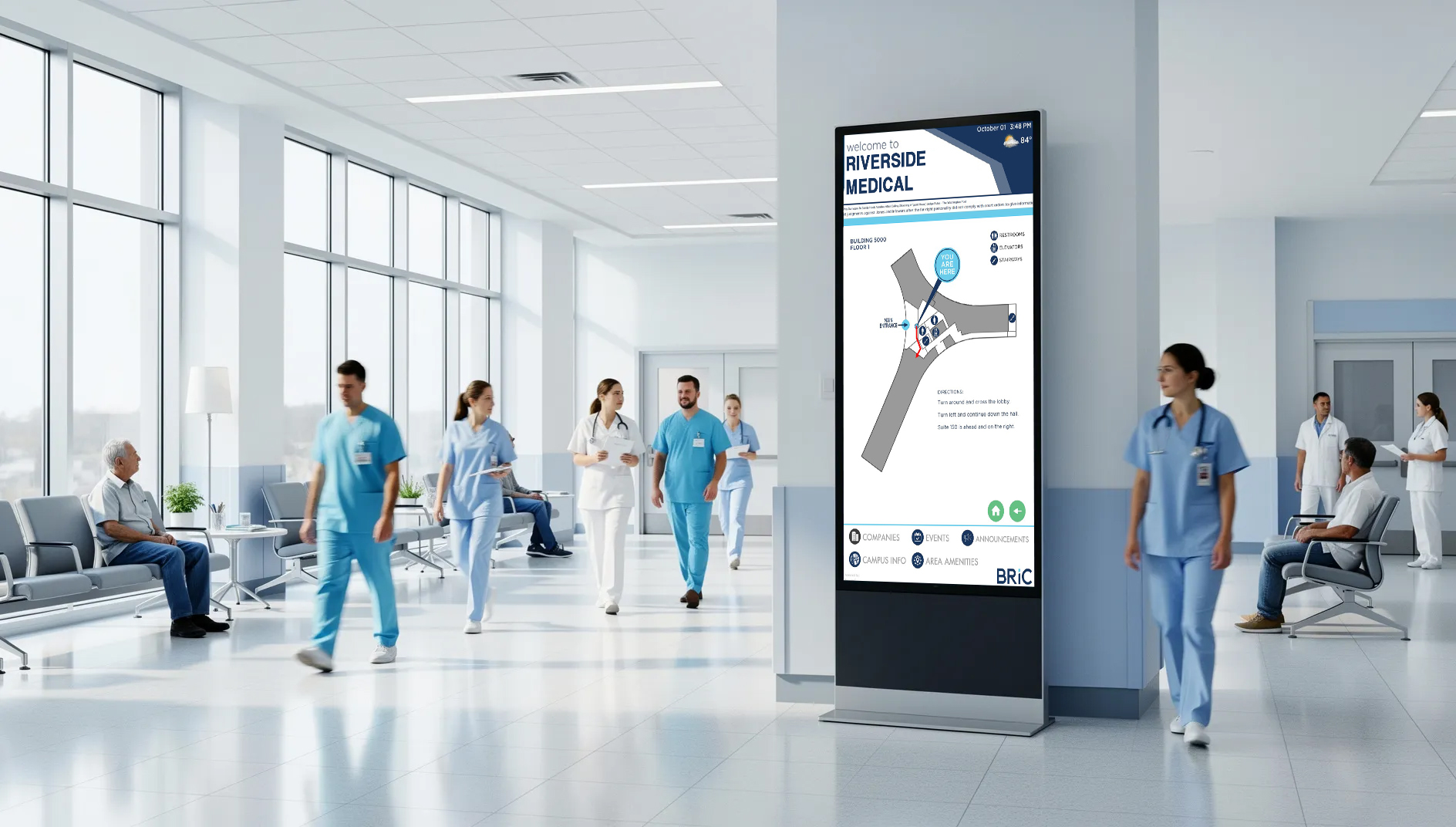
Wayfinding in Complex Healthcare Campuses: The Navigation Challenge at ScaleWestern Washington's major health system campuses are among the most complex navigational environments their patients and visitors will ever encounter. UW Medical Center's multi-building Seattle campus. Providence Regional Medical Center Everett's sprawling Colby campus. OHSU's dramatic hilltop Portland campus with its aerial tram connection to the South Waterfront. MultiCare's Tacoma General Hospital complex. These are not environments where a lobby directory and a few corridor signs constitute an adequate wayfinding solution. For patients navigating to an unfamiliar clinic, a family member trying to find a patient's room, or a visitor attempting to locate the cafeteria, pharmacy, or parking validation, wayfinding in a large healthcare campus is genuinely stressful — and that stress compounds the anxiety that most people already carry into a healthcare environment. A study published in Health Environments Research & Design Journal found that patient and visitor wayfinding difficulty is directly correlated with elevated stress responses and reduced satisfaction scores, and that facilities deploying interactive wayfinding technology showed measurable improvements in both metrics.⁵ Interactive wayfinding kiosks — large-format touch-enabled directory and mapping terminals deployed at facility entrances, elevator lobbies, and major decision points throughout a campus — give patients and visitors the tools to navigate confidently and independently. A patient arriving at Providence's main entrance can search for their destination by department name, provider name, or service type, receive a step-by-step route with clear visual waypoints, and — in facilities with advanced wayfinding infrastructure — receive turn-by-turn guidance on a mobile device that continues as they move through the building. The operational benefit to clinical staff is equally significant. Nursing staff and clinical support teams in large healthcare facilities spend a non-trivial portion of their shifts giving directions to lost patients and visitors. Interactive wayfinding technology reduces this burden, allowing clinical staff to focus on patient care rather than navigation assistance — a particularly valuable efficiency gain in a workforce environment where nursing and clinical support staffing is consistently cited as a top operational challenge.
The Digital Health Room: Integrating Touch Screen Technology Across the Patient JourneyThe most forward-thinking health systems in Western Washington are moving beyond individual touch screen applications toward an integrated digital health room model — where touch-enabled technology is woven throughout the care environment in ways that support every stage of the patient journey. In this model, the patient experience begins with self-service check-in at the facility entrance, continues through digital wayfinding to the appropriate care area, and enters the exam room where an interactive patient education display supports the clinical consultation. Medication instructions, post-visit care plans, and follow-up scheduling can be presented on a touch-enabled display and sent directly to the patient's mobile device or patient portal. Post-visit satisfaction surveys can be completed on a kiosk at the facility exit, providing real-time feedback that care teams can act on immediately. This integration creates a care experience that feels coherent, informed, and responsive — one where technology serves the patient's needs at every step rather than appearing only at isolated points in the journey. For health systems building toward patient experience and HCAHPS score improvements, this integrated model is the architecture that delivers the most meaningful results. Accenture's 2023 Digital Health Technology Vision found that health systems pursuing integrated digital patient experience strategies — rather than point solutions — reported patient satisfaction improvements that were 2.3 times greater than those deploying isolated technology applications.⁶ For Western Washington's health systems making capital investment decisions about technology infrastructure, that finding makes a compelling case for thinking about touch screen technology as an integrated system rather than a collection of individual tools.
What Health System Leaders and Facility Planners Should KnowFor the clinical informatics directors, facility planners, patient experience officers, and CRE developers responsible for Western Washington's healthcare infrastructure, a few principles consistently characterize successful touch screen technology deployments in clinical environments. Clinical validation must precede deployment. Technology deployed in a clinical environment must meet the safety, infection control, and regulatory standards applicable to that environment. Working with a technology partner who understands these requirements — and who can document hardware compliance with relevant standards — is essential to a deployment that will withstand scrutiny from accreditation bodies and infection control programs. Integration with existing clinical systems is non-negotiable. Touch screen technology that operates in isolation from a health system's EHR, patient scheduling, and wayfinding platforms delivers a fraction of its potential value. The investment in integration — connecting check-in kiosks to the EHR, linking wayfinding systems to real-time facility data, and ensuring patient education systems align with clinical documentation workflows — is consistently justified by the operational and clinical outcomes it enables. Design for the most vulnerable users. Healthcare facilities serve patients who are anxious, in pain, elderly, unfamiliar with technology, and managing significant physical and cognitive challenges. Touch screen interfaces in clinical environments must be designed for this reality — with large, high-contrast text, intuitive navigation, multilingual support, and accessibility features that ensure every patient can use the technology effectively regardless of their physical or cognitive state.
Partner With ITS, Inc. to Elevate Patient CareITS, Inc. partners with Western Washington's leading health systems, hospital networks, and healthcare facility developers to design and deploy interactive touch screen solutions that improve patient experience, support clinical quality, and optimize facility operations. From self-service check-in kiosks and interactive patient education systems to medical-grade clinical carts and campus-wide wayfinding infrastructure, we bring the full spectrum of healthcare touch screen capability to the environments where it matters most.
Sources
Frequently Asked QuestionsHow do self-service check-in kiosks comply with HIPAA privacy requirements? Medical-grade self-service check-in kiosks are designed with HIPAA compliance as a core architectural requirement. This includes encrypted data transmission between the kiosk and the health system's EHR or practice management system, automatic session termination after each patient interaction, privacy screen filters that limit the viewing angle of patient information, and audit logging of all system interactions. ITS, Inc. works with health system IT and compliance teams to ensure every deployment meets applicable HIPAA technical safeguard requirements. What infection control standards do medical-grade touch screen carts meet? Medical-grade touch screen carts are constructed with materials and surface treatments validated for compatibility with hospital-grade disinfectants, including quaternary ammonium compounds, hydrogen peroxide solutions, and bleach-based cleaners. They feature IP-rated sealed enclosures that protect electronics from liquid ingress during cleaning, and are manufactured to meet relevant IEC and UL standards for medical electrical equipment. ITS, Inc. provides documentation of disinfectant compatibility and cleaning protocols for all medical-grade hardware we specify. Can interactive patient education systems integrate with a health system's existing EHR platform? Yes. Leading interactive patient education platforms are designed with EHR integration capabilities that allow patient-specific content to be surfaced during consultations based on the patient's diagnosis, care plan, and clinical context. Integration with Epic, Cerner, and other major EHR platforms is well-supported, and ITS, Inc. works with health system clinical informatics teams to design integration architectures that fit within existing technical infrastructure and governance frameworks. How do interactive wayfinding systems stay current as healthcare campuses change? Modern healthcare wayfinding platforms use cloud-based content management systems that allow facility teams to update maps, directory listings, and routing information in real time — without requiring hardware changes or vendor intervention. When a department relocates, a new clinic opens, or a construction project temporarily closes a corridor, the wayfinding system can be updated immediately across all terminals in the facility. ITS, Inc. provides training and ongoing support to ensure facility teams can manage content updates efficiently and confidently. What is the ROI timeline for interactive touch screen technology in a healthcare setting? ROI timelines in healthcare settings are shaped by multiple value streams — patient experience score improvements affecting value-based care reimbursement, operational efficiency gains from reduced registration times and staff burden reduction, clinical quality improvements from better patient education and adherence, and infection control benefits from clinical-grade equipment. Health systems that model these value streams comprehensively typically identify payback periods of 18–36 months for comprehensive deployments, with ongoing annual returns from reimbursement performance and operational efficiency. How does ITS, Inc. support health systems through regulatory and accreditation requirements? ITS, Inc. brings deep experience in healthcare technology deployment — including familiarity with Joint Commission environment of care standards, CMS Conditions of Participation, HIPAA technical safeguard requirements, and state department of health regulations applicable to healthcare facility technology. We work closely with health system compliance, infection control, and facilities teams to ensure every deployment is designed, installed, and documented in ways that support rather than complicate accreditation and regulatory compliance.
Contact us today to learn more about Navigo® for your property.  |

7150 Columbia Gateway Drive, Suite L, Columbia, MD 21046
112 West 34th Street, 18th floor, Room 18025 New York, NY 10001
Proud Member

7150 Columbia Gateway Drive, Suite L
Columbia, MD 21046
112 West 34th Street, 18-025
New York, NY 10001
